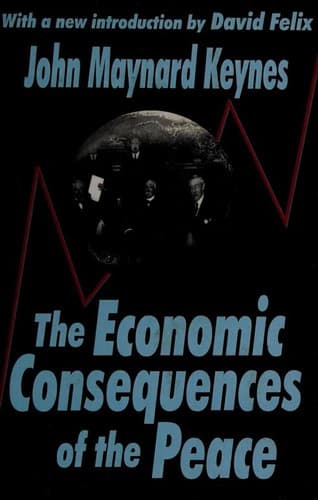
The Economic Consequences of the PeaceKeynes, John Maynard
History
The Economic Consequences of the Peace
Keynes, John Maynard
Economic history -- 1918-1945; Treaty of Versailles (1919 June 28); World War, 1914-1918 -- Economic aspects
The essential facts of the situation, as I see them, are expressed
simply. Europe consists of the densest aggregation of population in the
history of the world. This population is accustomed to a relatively high
standard of life, in which, even now, some sections of it anticipate
improvement rather than deterioration. In relation to other continents
Europe is not self-sufficient; in particular it cannot feed Itself.
Internally the population is not evenly distributed, but much of it is
crowded into a relatively small number of dense industrial centers. This
population secured for itself a livelihood before the war, without much
margin of surplus, by means of a delicate and immensely complicated
organization, of which the foundations were supported by coal, iron,
transport, and an unbroken supply of imported food and raw materials
from other continents. By the destruction of this organization and the
interruption of the stream of supplies, a part of this population is
deprived of its means of livelihood. Emigration is not open to the
redundant surplus. For it would take years to transport them overseas,
even, which is not the case, if countries could be found which were
ready to receive them. The danger confronting us, therefore, is the
rapid depression of the standard of life of the European populations to
a point which will mean actual starvation for some (a point already
reached in Russia and approximately reached in Austria). Men will not
always die quietly. For starvation, which brings to some lethargy and a
helpless despair, drives other temperaments to the nervous instability
of hysteria and to a mad despair. And these in their distress may
overturn the remnants of organization, and submerge civilization itself
in their attempts to satisfy desperately the overwhelming needs of the
individual. This is the danger against which all our resources and
courage and idealism must now co-operate.
Public-domain text, read in full here on John Shaqi.
Reviews
Reviews
No reviews yet
Be the first to share your thoughts on this work.
Elsewhere in the archive
Join the Discussion
Join the discussion
Sign in to leave a comment or review.
Sign InorCreate an account