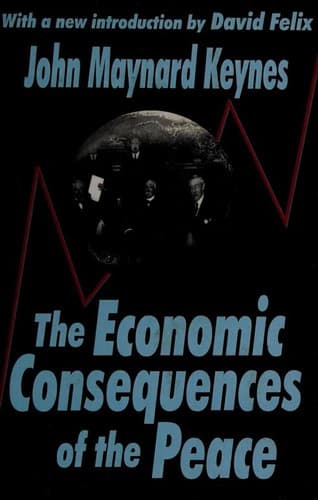
The Economic Consequences of the PeaceKeynes, John Maynard
History
The Economic Consequences of the Peace
Keynes, John Maynard
Economic history -- 1918-1945; Treaty of Versailles (1919 June 28); World War, 1914-1918 -- Economic aspects
(4) The Coal Commission already established by the Allies should become
an appanage of the League of Nations, and should be enlarged to include
representatives of Germany and the other States of Central and Eastern
Europe, of the Northern Neutrals, and of Switzerland. Its authority
should be advisory only, but should extend over the distribution of the
coal supplies of Germany, Poland, and the constituent parts of the
former Austro-Hungarian Empire, and of the exportable surplus of the
United Kingdom. All the States represented on the Commission should
undertake to furnish it with the fullest information, and to be guided
by its advice so far as their sovereignty and their vital interests
permit.
_Tariffs_.--A Free Trade Union should be established under the auspices
of the League of Nations of countries undertaking to impose no
protectionist tariffs[160] whatever against the produce of other members
of the Union, Germany, Poland, the new States which formerly composed
the Austro-Hungarian and Turkish Empires, and the Mandated States should
be compelled to adhere to this Union for ten years, after which time
adherence would be voluntary. The adherence of other States would be
voluntary from the outset. But it is to be hoped that the United
Kingdom, at any rate, would become an original member.
* * * * *
By fixing the Reparation payments well within Germany's capacity to pay,
we make possible the renewal of hope and enterprise within her
territory, we avoid the perpetual friction and opportunity of improper
pressure arising out of Treaty clauses which are impossible of
fulfilment, and we render unnecessary the intolerable powers of the
Reparation Commission.
By a moderation of the clauses relating directly or indirectly to coal,
and by the exchange of iron-ore, we permit the continuance of Germany's
industrial life, and put limits on the loss of productivity which would
be brought about otherwise by the interference of political frontiers
with the natural localization of the iron and steel industry.
Public-domain text, read in full here on John Shaqi.
Reviews
Reviews
No reviews yet
Be the first to share your thoughts on this work.
Elsewhere in the archive
Join the Discussion
Join the discussion
Sign in to leave a comment or review.
Sign InorCreate an account