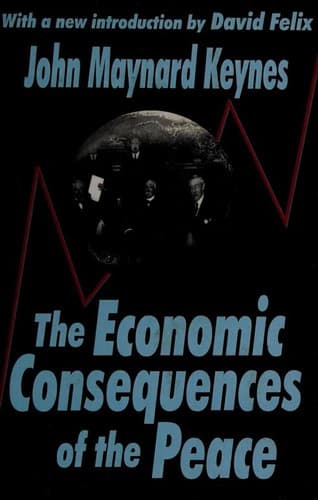
The Economic Consequences of the PeaceKeynes, John Maynard
History
The Economic Consequences of the Peace
Keynes, John Maynard
Economic history -- 1918-1945; Treaty of Versailles (1919 June 28); World War, 1914-1918 -- Economic aspects
President at their disposal, often acting in the teeth of European
obstruction, which not only saved an immense amount of human suffering,
but averted a widespread breakdown of the European system.[166]
But in speaking thus as we do of American financial assistance, we
tacitly assume, and America, I believe, assumed it too when she gave the
money, that it was not in the nature of an investment. If Europe is
going to repay the $10,000,000,000 worth of financial assistance which
she has had from the United States with compound interest at 5 per cent,
the matter takes on quite a different complexion. If America's advances
are to be regarded in this light, her relative financial sacrifice has
been very slight indeed.
Controversies as to relative sacrifice are very barren and very foolish
also; for there is no reason in the world why relative sacrifice should
necessarily be equal,--so many other very relevant considerations being
quite different in the two cases. The two or three facts following are
put forward, therefore, not to suggest that they provide any compelling
argument for Americans, but only to show that from his own selfish point
of view an Englishman is not seeking to avoid due sacrifice on his
country's part in making the present suggestion. (1) The sums which the
British Treasury borrowed from the American Treasury, after the latter
came into the war, were approximately offset by the sums which England
lent to her other Allies _during the same period_ (i.e. excluding sums
lent before the United States came into the war); so that almost the
whole of England's indebtedness to the United States was incurred, not
on her own account, but to enable her to assist the rest of her Allies,
who were for various reasons not in a position to draw their assistance
from the United States direct.[167] (2) The United Kingdom has disposed
of about $5,000,000,000 worth of her foreign securities, and in addition
has incurred foreign debt to the amount of about $6,000,000,000. The
United States, so far from selling, has bought back upwards of
$5,000,000,000, and has incurred practically no foreign debt. (3) The
population of the United Kingdom is about one-half that of the United
States, the income about one-third, and the accumulated wealth between
one-half and one-third. The financial capacity of the United Kingdom may
therefore be put at about two-fifths that of the United States. This
figure enables us to make the following comparison:--Excluding loans to
Allies in each case (as is right on the assumption that these loans are
to be repaid), the war expenditure of the United Kingdom has been about
three times that of the United Sates, or in proportion to capacity
between seven and eight times.
Having cleared this issue out of the way as briefly as possible, I turn
to the broader issues of the future relations between the parties to the
late war, by which the present proposal must primarily be judged.
Public-domain text, read in full here on John Shaqi.
Reviews
Reviews
No reviews yet
Be the first to share your thoughts on this work.
Elsewhere in the archive
Join the Discussion
Join the discussion
Sign in to leave a comment or review.
Sign InorCreate an account