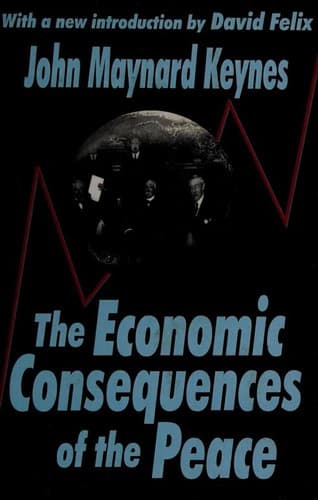
The Economic Consequences of the PeaceKeynes, John Maynard
History
The Economic Consequences of the Peace
Keynes, John Maynard
Economic history -- 1918-1945; Treaty of Versailles (1919 June 28); World War, 1914-1918 -- Economic aspects
[43] The Reparation Commission is authorized under the Treaty
(Part VIII Annex V. para. 10) "to postpone or to cancel deliveries" if
they consider "that the full exercise of the foregoing options would
interfere unduly with the industrial requirements of Germany." In the
event of such postponements or cancellations "the coal to replace coal
from destroyed mines shall receive priority over other deliveries." This
concluding clause is of the greatest importance, if, as will be seen, it
is physically impossible for Germany to furnish the full 45,000,000; for
it means that France will receive 20,000,000 tons before Italy receives
anything. The Reparation Commission has no discretion to modify this.
The Italian Press has not failed to notice the significance of the
provision, and alleges that this clause was inserted during the absence
of the Italian representatives from Paris (_Corriere della Sera_, July
19, 1919).
[44] It follows that the current rate of production in Germany
has sunk to about 60 per cent of that of 1913. The effect on reserves
has naturally been disastrous, and the prospects for the coming winter
are dangerous.
[45] This assumes a loss of output of 15 per cent as compared
with the estimate of 30 per cent quoted above.
[46] This supposes a loss of 23 per cent of Germany's
industrial undertaking and a diminution of 13 per cent in her other
requirements.
[47] The reader must be reminded in particular that the above
calculations take no account of the German production of lignite, which
yielded in 1913 13,000,000 tons of rough lignite in addition to an
amount converted into 21,000,000 tons of briquette. This amount of
lignite, however, was required in Germany before the war _in addition
to_ the quantities of coal assumed above. I am not competent to speak on
the extent to which the loss of coal can be made good by the extended
use of lignite or by economies in its present employment; but some
authorities believe that Germany may obtain substantial compensation for
her loss of coal by paying more attention to her deposits of lignite.
[48] Mr. Hoover, in July, 1919, estimated that the coal output
of Europe, excluding Russia and the Balkans, had dropped from
679,500,000 tons to 443,000,000 tons,--as a result in a minor degree of
loss of material and labor, but owing chiefly to a relaxation of
physical effort after the privations and sufferings of the war, a lack
of rolling-stock and transport, and the unsettled political fate of some
of the mining districts.
[49] Numerous commercial agreements during the war ware
arranged on these lines. But in the month of June, 1919, alone, minor
agreements providing for payment in coal were made by Germany with
Denmark, Norway, and Switzerland. The amounts involved were not large,
but without them Germany could not have obtained butter from Denmark,
fats and herrings from Norway, or milk and cattle from Switzerland.
Public-domain text, read in full here on John Shaqi.
Reviews
Reviews
No reviews yet
Be the first to share your thoughts on this work.
Elsewhere in the archive
Join the Discussion
Join the discussion
Sign in to leave a comment or review.
Sign InorCreate an account