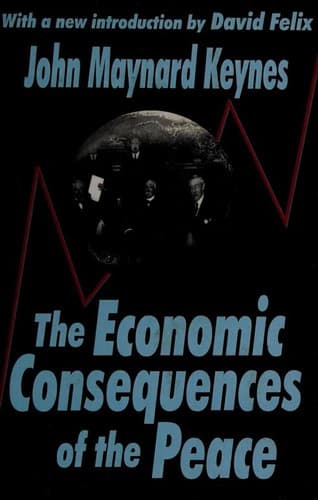
The Economic Consequences of the PeaceKeynes, John Maynard
History
The Economic Consequences of the Peace
Keynes, John Maynard
Economic history -- 1918-1945; Treaty of Versailles (1919 June 28); World War, 1914-1918 -- Economic aspects
[50] "Some 60,000 Ruhr miners have agreed to work extra
shifts--so-called butter-shifts--for the purpose of furnishing coal for
export to Denmark hence butter will be exported in return. The butter
will benefit the miners in the first place, as they have worked
specially to obtain it" (_Kˆlnische Zeitung_, June 11, 1919).
[51] What of the prospects of whisky-shifts in England?
[52] As early as September, 1919, the Coal Commission had to
face the physical impracticability of enforcing the demands of the
Treaty, and agreed to modify them as follows:--"Germany shall in the
next six months make deliveries corresponding to an annual delivery of
20 million tons as compared with 43 millions as provided in the Peace
Treaty. If Germany's total production exceeds the present level of about
108 millions a year, 60 per cent of extra production, up to 128
millions, shall be delivered to the Entente and 50 per cent of any extra
beyond that, until the figure provided in the Peace Treaty is reached.
If the total production falls below 108 millions the Entente will
examine the situation, after hearing Germany, and take account of it."
[53] 21,136,265 tons out of a total of 28,607,903 tons. The
loss of iron-ore in respect of Upper Silesia is insignificant. The
exclusion of the iron and steel of Luxemburg from the German Customs
Union is, however, important, especially when this loss is added to that
of Alsace-Lorraine. It may be added in passing that Upper Silesia
includes 75 per cent of the zinc production of Germany.
[54] In April, 1919, the British Ministry of Munitions
despatched an expert Commission to examine the conditions of the iron
and steel works in Lorraine and the occupied areas of Germany. The
Report states that the iron and steel works in Lorraine, and to a lesser
extent in the Saar Valley, are dependent on supplies of coal and coke
from Westphalia. It is necessary to mix Westphalian coal with Saar coal
to obtain a good furnace coke. The entire dependence of all the Lorraine
iron and steel works upon Germany for fuel supplies "places them," says
the Report, "in a very unenviable position."
[55] Arts. 264, 265, 266, and 267. These provisions can only be
extended beyond five years by the Council of the League of Nations.
[56] Art. 268 (_a_).
[57] Art. 268 (_b_) and (_c_).
[58] The Grand Duchy is also deneutralized and Germany binds
herself to "accept in advance all international arrangements which may
be concluded by the Allied and Associated Powers relating to the Grand
Duchy" (Art. 40). At the end of September, 1919, a plebiscite was held
to determine whether Luxemburg should join the French or the Belgian
Customs Union, which decided by a substantial majority in favour of the
former. The third alternative of the maintenance of the union with
Germany was not left open to the electorate.
[59] Art. 269.
[60] Art. 270.
Public-domain text, read in full here on John Shaqi.
Reviews
Reviews
No reviews yet
Be the first to share your thoughts on this work.
Elsewhere in the archive
Join the Discussion
Join the discussion
Sign in to leave a comment or review.
Sign InorCreate an account