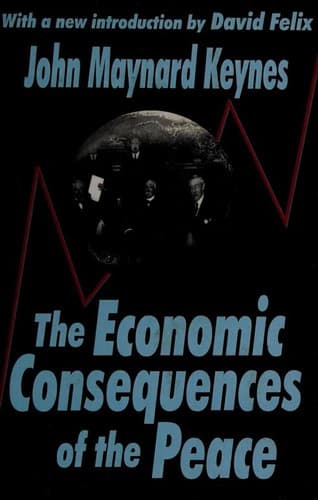
The Economic Consequences of the PeaceKeynes, John Maynard
History
The Economic Consequences of the Peace
Keynes, John Maynard
Economic history -- 1918-1945; Treaty of Versailles (1919 June 28); World War, 1914-1918 -- Economic aspects
But there are not only the limitations of the phrase in its natural
meaning and the emphasis on civilian damages as distinct from military
expenditure generally; it must also be remembered that the context of
the term is in elucidation of the meaning of the term "restoration" in
the President's Fourteen Points. The Fourteen Points provide for damage
in invaded territory--Belgium, France, Roumania, Serbia, and Montenegro
(Italy being unaccountably omitted)--but they do not cover losses at sea
by submarine, bombardments from the sea (as at Scarborough), or damage
done by air raids. It was to repair these omissions, which involved
losses to the life and property of civilians not really distinguishable
in kind from those effected in occupied territory, that the Supreme
Council of the Allies in Paris proposed to President Wilson their
qualifications. At that time--the last days of October, 1918--I do not
believe that any responsible statesman had in mind the exaction from
Germany of an indemnity for the general costs of the war. They sought
only to make it clear (a point of considerable importance to Great
Britain) that reparation for damage done to non-combatants and their
property was not limited to invaded territory (as it would have been by
the Fourteen Points unqualified), but applied equally to _all_ such
damage, whether "by land, by sea, or from the air" It was only at a
later stage that a general popular demand for an indemnity, covering
the full costs of the war, made it politically desirable to practise
dishonesty and to try to discover in the written word what was not
there.
What damages, then, can be claimed from the enemy on a strict
interpretation of our engagements?[77] In the case of the United Kingdom
the bill would cover the following items:--
(a) Damage to civilian life and property by the acts of an enemy
Government including damage by air raids, naval bombardments, submarine
warfare, and mines.
(b) Compensation for improper treatment of interned civilians.
It would not include the general costs of the war, or (_e.g._) indirect
damage due to loss of trade.
The French claim would include, as well as items corresponding to the
above:--
(c) Damage done to the property and persons of civilians in the war
area, and by aerial warfare behind the enemy lines.
(d) Compensation for loot of food, raw materials, live-stock, machinery,
household effects, timber, and the like by the enemy Governments or
their nationals in territory occupied by them.
(e) Repayment of fines and requisitions levied by the enemy Governments
or their officers on French municipalities or nationals.
(f) Compensation to French nationals deported or compelled to do forced
labor.
In addition to the above there is a further item of more doubtful
character, namely--
(g) The expenses of the Relief Commission in providing necessary food
and clothing to maintain the civilian French population in the
enemy-occupied districts.
Public-domain text, read in full here on John Shaqi.
Reviews
Reviews
No reviews yet
Be the first to share your thoughts on this work.
Elsewhere in the archive
Join the Discussion
Join the discussion
Sign in to leave a comment or review.
Sign InorCreate an account