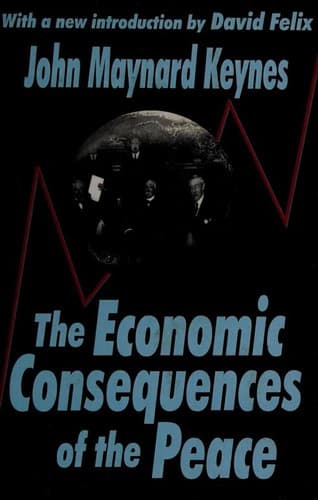
The Economic Consequences of the PeaceKeynes, John Maynard
History
The Economic Consequences of the Peace
Keynes, John Maynard
Economic history -- 1918-1945; Treaty of Versailles (1919 June 28); World War, 1914-1918 -- Economic aspects
The progress of the General Election of 1918 affords a sad, dramatic
history of the essential weakness of one who draws his chief inspiration
not from his own true impulses, but from the grosser effluxions of the
atmosphere which momentarily surrounds him. The Prime Minister's natural
instincts, as they so often are, were right and reasonable. He himself
did not believe in hanging the Kaiser or in the wisdom or the
possibility of a great indemnity. On the 22nd of November he and Mr.
Bonar Law issued their Election Manifesto. It contains no allusion of
any kind either to the one or to the other but, speaking, rather, of
Disarmament and the League of Nations, concludes that "our first task
must be to conclude a just and lasting peace, and so to establish the
foundations of a new Europe that occasion for further wars may be for
ever averted." In his speech at Wolverhampton on the eve of the
Dissolution (November 24), there is no word of Reparation or Indemnity.
On the following day at Glasgow, Mr. Bonar Law would promise nothing.
"We are going to the Conference," he said, "as one of a number of
allies, and you cannot expect a member of the Government, whatever he
may think, to state in public before he goes into that Conference, what
line he is going to take in regard to any particular question." But a
few days later at Newcastle (November 29) the Prime Minister was warming
to his work: "When Germany defeated France she made France pay. That is
the principle which she herself has established. There is absolutely no
doubt about the principle, and that is the principle we should proceed
upon--that Germany must pay the costs of the war up to the limit of her
capacity to do so." But he accompanied this statement of principle with
many "words of warning" as to the practical difficulties of the case:
"We have appointed a strong Committee of experts, representing every
shade of opinion, to consider this question very carefully and to advise
us. There is no doubt as to the justice of the demand. She ought to pay,
she must pay as far as she can, but we are not going to allow her to pay
in such a way as to wreck our industries." At this stage the Prime
Minister sought to indicate that he intended great severity, without
raising excessive hopes of actually getting the money, or committing
himself to a particular line of action at the Conference. It was
rumored that a high city authority had committed himself to the opinion
that Germany could certainly pay $100,000,000,000 and that this
authority for his part would not care to discredit a figure of twice
that sum. The Treasury officials, as Mr. Lloyd George indicated, took a
different view. He could, therefore, shelter himself behind the wide
discrepancy between the opinions of his different advisers, and regard
the precise figure of Germany's capacity to pay as an open question in
the treatment of which he must do his best for his country's interests.
Public-domain text, read in full here on John Shaqi.
Reviews
Reviews
No reviews yet
Be the first to share your thoughts on this work.
Elsewhere in the archive
Join the Discussion
Join the discussion
Sign in to leave a comment or review.
Sign InorCreate an account