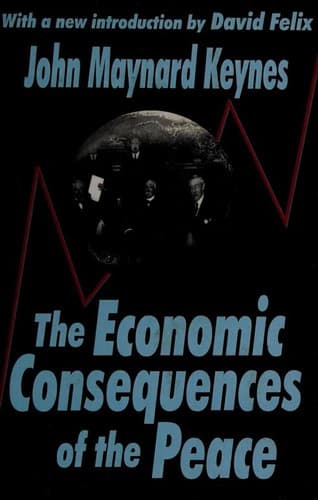
The Economic Consequences of the PeaceKeynes, John Maynard
History
The Economic Consequences of the Peace
Keynes, John Maynard
Economic history -- 1918-1945; Treaty of Versailles (1919 June 28); World War, 1914-1918 -- Economic aspects
What had really happened was a compromise between the Prime Minister's
pledge to the British electorate to claim the entire costs of the war
and the pledge to the contrary which the Allies had given to Germany at
the Armistice. The Prime Minister could claim that although he had not
secured the entire costs of the war, he had nevertheless secured an
important contribution towards them, that he had always qualified his
promises by the limiting condition of Germany's capacity to pay, and
that the bill as now presented more than exhausted this capacity as
estimated by the more sober authorities. The President, on the other
hand, had secured a formula, which was not too obvious a breach of
faith, and had avoided a quarrel with his Associates on an issue where
the appeals to sentiment and passion would all have been against him, in
the event of its being made a matter of open popular controversy. In
view of the Prime Minister's election pledges, the President could
hardly hope to get him to abandon them in their entirety without a
struggle in public; and the cry of pensions would have had an
overwhelming popular appeal in all countries. Once more the Prime
Minister had shown himself a political tactician of a high order.
A further point of great difficulty may be readily perceived between the
lines of the Treaty. It fixes no definite sum as representing Germany's
liability. This feature has been the subject of very general
criticism,--that it is equally inconvenient to Germany and to the Allies
themselves that she should not know what she has to pay or they what
they are to receive. The method, apparently contemplated by the Treaty,
of arriving at the final result over a period of many months by an
addition of hundreds of thousands of individual claims for damage to
land, farm buildings, and chickens, is evidently impracticable; and the
reasonable course would have been for both parties to compound for a
round sum without examination of details. If this round sum had been
named in the Treaty, the settlement would have been placed on a more
business-like basis.
Public-domain text, read in full here on John Shaqi.
Reviews
Reviews
No reviews yet
Be the first to share your thoughts on this work.
Elsewhere in the archive
Join the Discussion
Join the discussion
Sign in to leave a comment or review.
Sign InorCreate an account