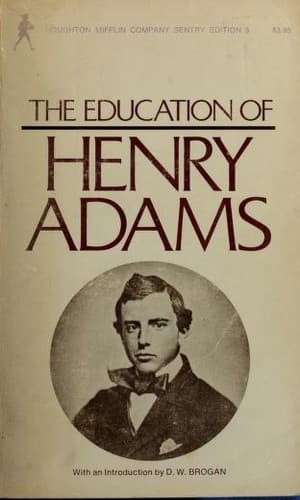
Adams, Henry, 1838-1918; Historians -- United States -- Biography
John Morley's comment on this matter, in the "Life of
Gladstone," forty years afterwards, would have interested the Minister,
as well as his private secretary: "If this relation be accurate," said
Morley of a relation officially published at the time, and never
questioned, "then the Foreign Secretary did not construe strict
neutrality as excluding what diplomatists call good offices." For a
vital lesson in politics, Earl Russell's construction of neutrality
mattered little to the student, who asked only Russell's intent, and
cared only to know whether his construction had any other object than
to deceive the Minister.
In the grave one can afford to be lavish of charity, and
possibly Earl Russell may have been honestly glad to reassure his
personal friend Mr. Adams; but to one who is still in the world even if
not of it, doubts are as plenty as days. Earl Russell totally deceived
the private secretary, whatever he may have done to the Minister. The
policy of abstention was not settled on October 23. Only the next day,
October 24, Gladstone circulated a rejoinder to G. C. Lewis, insisting
on the duty of England, France, and Russia to intervene by
representing, "with moral authority and force, the opinion of the
civilized world upon the conditions of the case." Nothing had been
decided. By some means, scarcely accidental, the French Emperor was led
to think that his influence might turn the scale, and only ten days
after Russell's categorical "Yes!" Napoleon officially invited him to
say "No!" He was more than ready to do so. Another Cabinet meeting was
called for November 11, and this time Gladstone himself reports the
debate:
Nov. 11. We have had our Cabinet to-day and meet again
tomorrow. I am afraid we shall do little or nothing in the
business of America. But I will send you definite intelligence.
Both Lords Palmerston and Russell are right.
Nov. 12. The United States affair has ended and not well. Lord
Russell rather turned tail. He gave way without resolutely
fighting out his battle. However, though we decline for the
moment, the answer is put upon grounds and in terms which leave
the matter very open for the future.
Nov. 13. I think the French will make our answer about America
public; at least it is very possible. But I hope they may not
take it as a positive refusal, or at any rate that they may
themselves act in the matter. It will be clear that we concur
with them, that the war should cease. Palmerston gave to
Russell's proposal a feeble and half-hearted support.
Public-domain text, read in full here on John Shaqi.
Reviews
Reviews
No reviews yet
Be the first to share your thoughts on this work.
Elsewhere in the archive
Join the Discussion
Join the discussion
Sign in to leave a comment or review.
Sign InorCreate an account