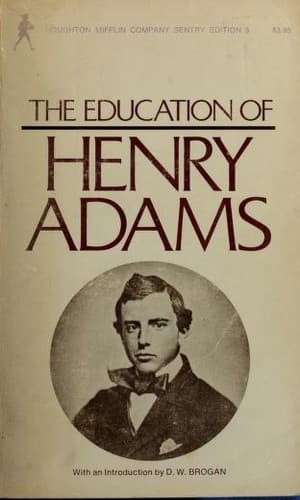
Adams, Henry, 1838-1918; Historians -- United States -- Biography
Other people could afford to laugh at a young man's blunders,
but to him the best part of life was thrown away if he learned such a
lesson wrong. Henry James had not yet taught the world to read a volume
for the pleasure of seeing the lights of his burning-glass turned on
alternate sides of the same figure. Psychological study was still
simple, and at worst--or at best--English character was never subtile.
Surely no one would believe that complexity was the trait that confused
the student of Palmerston, Russell, and Gladstone. Under a very strong
light human nature will always appear complex and full of
contradictions, but the British statesman would appear, on the whole,
among the least complex of men.
Complex these gentlemen were not. Disraeli alone might, by
contrast, be called complex, but Palmerston, Russell, and Gladstone
deceived only by their simplicity. Russell was the most interesting to
a young man because his conduct seemed most statesmanlike. Every act of
Russell, from April, 1861, to November, 1862, showed the clearest
determination to break up the Union. The only point in Russell's
character about which the student thought no doubt to be possible was
its want of good faith. It was thoroughly dishonest, but strong.
Habitually Russell said one thing and did another. He seemed
unconscious of his own contradictions even when his opponents pointed
them out, as they were much in the habit of doing, in the strongest
language. As the student watched him deal with the Civil War in
America, Russell alone showed persistence, even obstinacy, in a
definite determination, which he supported, as was necessary, by the
usual definite falsehoods. The young man did not complain of the
falsehoods; on the contrary, he was vain of his own insight in
detecting them; but he was wholly upset by the idea that Russell should
think himself true.
Young Adams thought Earl Russell a statesman of the old school,
clear about his objects and unscrupulous in his methods--dishonest but
strong. Russell ardently asserted that he had no objects, and that
though he might be weak he was above all else honest. Minister Adams
leaned to Russell personally and thought him true, but officially, in
practice, treated him as false. Punch, before 1862, commonly drew
Russell as a schoolboy telling lies, and afterwards as prematurely
senile, at seventy. Education stopped there. No one, either in or out
of England, ever offered a rational explanation of Earl Russell.
Public-domain text, read in full here on John Shaqi.
Reviews
Reviews
No reviews yet
Be the first to share your thoughts on this work.
Elsewhere in the archive
Join the Discussion
Join the discussion
Sign in to leave a comment or review.
Sign InorCreate an account