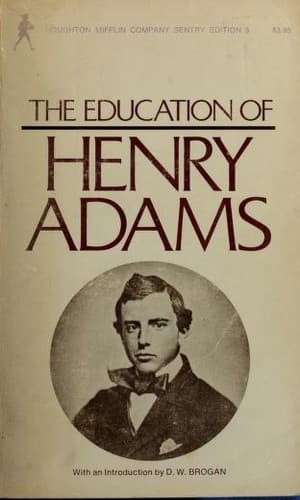
Adams, Henry, 1838-1918; Historians -- United States -- Biography
Since no other path seemed to offer itself, he stuck to his
plan of joining the press, and selected Washington as the shortest road
to New York, but, in 1868, Washington stood outside the social pale. No
Bostonian had ever gone there. One announced one's self as an
adventurer and an office-seeker, a person of deplorably bad judgment,
and the charges were true. The chances of ending in the gutter were, at
best, even. The risk was the greater in Adams's case, because he had no
very clear idea what to do when he got there. That he must educate
himself over again, for objects quite new, in an air altogether hostile
to his old educations, was the only certainty; but how he was to do
it--how he was to convert the idler in Rotten Row into the lobbyist of
the Capital--he had not an idea, and no one to teach him. The question
of money is rarely serious for a young American unless he is married,
and money never troubled Adams more than others; not because he had it,
but because he could do without it, like most people in Washington who
all lived on the income of bricklayers; but with or without money he
met the difficulty that, after getting to Washington in order to go on
the press, it was necessary to seek a press to go on. For large work he
could count on the North American Review, but this was scarcely a
press. For current discussion and correspondence, he could depend on
the New York Nation; but what he needed was a New York daily, and no
New York daily needed him. He lost his one chance by the death of Henry
J. Raymond. The Tribune under Horace Greeley was out of the question
both for political and personal reasons, and because Whitelaw Reid had
already undertaken that singularly venturesome position, amid
difficulties that would have swamped Adams in four-and-twenty hours.
Charles A. Dana had made the Sun a very successful as well as a very
amusing paper, but had hurt his own social position in doing it; and
Adams knew himself well enough to know that he could never please
himself and Dana too; with the best intentions, he must always fail as
a blackguard, and at that time a strong dash of blackguardism was life
to the Sun. As for the New York Herald, it was a despotic empire
admitting no personality but that of Bennett. Thus, for the moment, the
New York daily press offered no field except the free-trade Holy Land
of the Evening Post under William Cullen Bryant, while beside it lay
only the elevated plateau of the New Jerusalem occupied by Godkin and
the Nation. Much as Adams liked Godkin, and glad as he was to creep
under the shelter of the Evening Post and the Nation, he was well aware
that he should find there only the same circle of readers that he
reached in the North American Review.
Public-domain text, read in full here on John Shaqi.
Reviews
Reviews
No reviews yet
Be the first to share your thoughts on this work.
Elsewhere in the archive
Join the Discussion
Join the discussion
Sign in to leave a comment or review.
Sign InorCreate an account