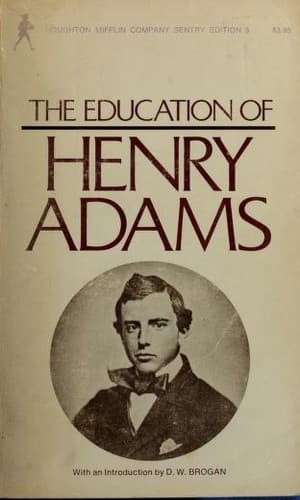
Adams, Henry, 1838-1918; Historians -- United States -- Biography
Adams did not feel Grant as a hostile force; like Badeau he saw
only an uncertain one. When in action he was superb and safe to follow;
only when torpid he was dangerous. To deal with him one must stand
near, like Rawlins, and practice more or less sympathetic habits.
Simple-minded beyond the experience of Wall Street or State Street, he
resorted, like most men of the same intellectual calibre, to
commonplaces when at a loss for expression: "Let us have peace!" or,
"The best way to treat a bad law is to execute it"; or a score of such
reversible sentences generally to be gauged by their sententiousness;
but sometimes he made one doubt his good faith; as when he seriously
remarked to a particularly bright young woman that Venice would be a
fine city if it were drained. In Mark Twain, this suggestion would have
taken rank among his best witticisms; in Grant it was a measure of
simplicity not singular. Robert E. Lee betrayed the same intellectual
commonplace, in a Virginian form, not to the same degree, but quite
distinctly enough for one who knew the American. What worried Adams was
not the commonplace; it was, as usual, his own education. Grant fretted
and irritated him, like the Terebratula, as a defiance of first
principles. He had no right to exist. He should have been extinct for
ages. The idea that, as society grew older, it grew one-sided, upset
evolution, and made of education a fraud. That, two thousand years
after Alexander the Great and Julius Caesar, a man like Grant should be
called--and should actually and truly be--the highest product of the
most advanced evolution, made evolution ludicrous. One must be as
commonplace as Grant's own commonplaces to maintain such an absurdity.
The progress of evolution from President Washington to President Grant,
was alone evidence enough to upset Darwin.
Education became more perplexing at every phase. No theory was
worth the pen that wrote it. America had no use for Adams because he
was eighteenth-century, and yet it worshipped Grant because he was
archaic and should have lived in a cave and worn skins. Darwinists
ought to conclude that America was reverting to the stone age, but the
theory of reversion was more absurd than that of evolution. Grant's
administration reverted to nothing. One could not catch a trait of the
past, still less of the future. It was not even sensibly American. Not
an official in it, except perhaps Rawlins whom Adams never met, and who
died in September, suggested an American idea.
Public-domain text, read in full here on John Shaqi.
Reviews
Reviews
No reviews yet
Be the first to share your thoughts on this work.
Elsewhere in the archive
Join the Discussion
Join the discussion
Sign in to leave a comment or review.
Sign InorCreate an account