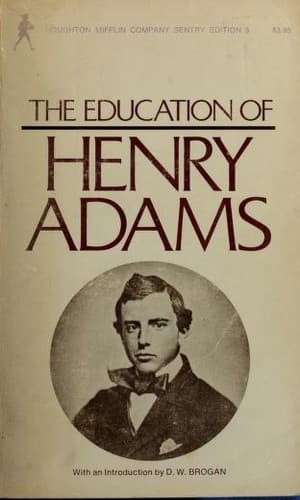
Adams, Henry, 1838-1918; Historians -- United States -- Biography
THE old New Englander was apt to be a solitary animal, but the
young New Englander was sometimes human. Judge Hoar brought his son Sam
to Washington, and Sam Hoar loved largely and well. He taught Adams the
charm of Washington spring. Education for education, none ever compared
with the delight of this. The Potomac and its tributaries squandered
beauty. Rock Creek was as wild as the Rocky Mountains. Here and there a
negro log cabin alone disturbed the dogwood and the judas-tree, the
azalea and the laurel. The tulip and the chestnut gave no sense of
struggle against a stingy nature. The soft, full outlines of the
landscape carried no hidden horror of glaciers in its bosom. The
brooding heat of the profligate vegetation; the cool charm of the
running water; the terrific splendor of the June thunder-gust in the
deep and solitary woods, were all sensual, animal, elemental. No
European spring had shown him the same intermixture of delicate grace
and passionate depravity that marked the Maryland May. He loved it too
much, as though it were Greek and half human. He could not leave it,
but loitered on into July, falling into the Southern ways of the summer
village about La Fayette Square, as one whose rights of inheritance
could not be questioned. Few Americans were so poor as to question them.
In spite of the fatal deception--or undeception--about
Grant's political character, Adams's first winter in Washington had so
much amused him that he had not a thought of change. He loved it too
much to question its value. What did he know about its value, or what
did any one know? His father knew more about it than any one else in
Boston, and he was amused to find that his father, whose recollections
went back to 1820, betrayed for Washington much the same sentimental
weakness, and described the society about President Monroe much as his
son felt the society about President Johnson. He feared its effect on
young men, with some justice, since it had been fatal to two of his
brothers; but he understood the charm, and he knew that a life in
Quincy or Boston was not likely to deaden it.
Public-domain text, read in full here on John Shaqi.
Reviews
Reviews
No reviews yet
Be the first to share your thoughts on this work.
Elsewhere in the archive
Join the Discussion
Join the discussion
Sign in to leave a comment or review.
Sign InorCreate an account