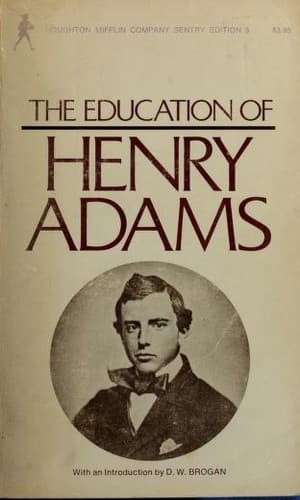
Adams, Henry, 1838-1918; Historians -- United States -- Biography
The unravelling a skein so tangled as that of the Erie Railway
was a task that might have given months of labor to the most efficient
District Attorney, with all his official tools to work with. Charles
took the railway history; Henry took the so-called Gold Conspiracy; and
they went to New York to work it up. The surface was in full view. They
had no trouble in Wall Street, and they paid their respects in person
to the famous Jim Fisk in his Opera-House Palace; but the New York side
of the story helped Henry little. He needed to penetrate the political
mystery, and for this purpose he had to wait for Congress to meet. At
first he feared that Congress would suppress the scandal, but the
Congressional Investigation was ordered and took place. He soon knew
all that was to be known; the material for his essay was furnished by
the Government.
Material furnished by a government seldom satisfies critics or
historians, for it lies always under suspicion. Here was a mystery, and
as usual, the chief mystery was the means of making sure that any
mystery existed. All Adams's great friends--Fish, Cox, Hoar, Evarts,
Sumner, and their surroundings--were precisely the persons most
mystified. They knew less than Adams did; they sought information, and
frankly admitted that their relations with the White House and the
Treasury were not confidential. No one volunteered advice. No one
offered suggestion. One got no light, even from the press, although
press agents expressed in private the most damning convictions with
their usual cynical frankness. The Congressional Committee took a
quantity of evidence which it dared not probe, and refused to analyze.
Although the fault lay somewhere on the Administration, and could lie
nowhere else, the trail always faded and died out at the point where
any member of the Administration became visible. Every one dreaded to
press inquiry. Adams himself feared finding out too much. He found out
too much already, when he saw in evidence that Jay Gould had actually
succeeded in stretching his net over Grant's closest surroundings, and
that Boutwell's incompetence was the bottom of Gould's calculation.
With the conventional air of assumed confidence, every one in public
assured every one else that the President himself was the savior of the
situation, and in private assured each other that if the President had
not been caught this time, he was sure to be trapped the next, for the
ways of Wall Street were dark and double. All this was wildly exciting
to Adams. That Grant should have fallen, within six months, into such a
morass--or should have let Boutwell drop him into it--rendered the
outlook for the next four years--probably eight--possibly
twelve--mysterious, or frankly opaque, to a young man who had hitched
his wagon, as Emerson told him, to the star of reform. The country
might outlive it, but not he. The worst scandals of the eighteenth
century were relatively harmless by the side of this, which smirched
Public-domain text, read in full here on John Shaqi.
Reviews
Reviews
No reviews yet
Be the first to share your thoughts on this work.
Elsewhere in the archive
Join the Discussion
Join the discussion
Sign in to leave a comment or review.
Sign InorCreate an account