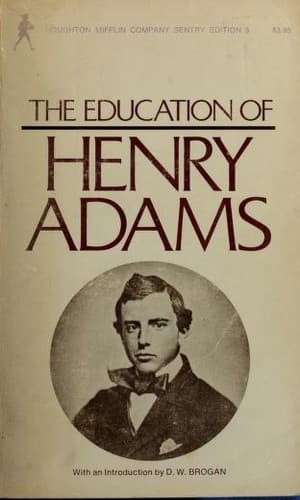
Adams, Henry, 1838-1918; Historians -- United States -- Biography
Yet the spectacle was no laughing matter to him, whatever it
might be to the public. Society is immoral and immortal; it can afford
to commit any kind of folly, and indulge in any sort of vice; it cannot
be killed, and the fragments that survive can always laugh at the dead;
but a young man has only one chance, and brief time to seize it. Any
one in power above him can extinguish the chance. He is horribly at the
mercy of fools and cowards. One dull administration can rapidly drive
out every active subordinate. At Washington, in 1869-70, every
intelligent man about the Government prepared to go. The people would
have liked to go too, for they stood helpless before the chaos; some
laughed and some raved; all were disgusted; but they had to content
themselves by turning their backs and going to work harder than ever on
their railroads and foundries. They were strong enough to carry even
their politics. Only the helpless remained stranded in Washington.
The shrewdest statesman of all was Mr. Boutwell, who showed how
he understood the situation by turning out of the Treasury every one
who could interfere with his repose, and then locking himself up in it,
alone. What he did there, no one knew. His colleagues asked him in
vain. Not a word could they get from him, either in the Cabinet or out
of it, of suggestion or information on matters even of vital interest.
The Treasury as an active influence ceased to exist. Mr. Boutwell
waited with confidence for society to drag his department out of the
mire, as it was sure to do if he waited long enough.
Warned by his friends in the Cabinet as well as in the Treasury
that Mr. Boutwell meant to invite no support, and cared to receive
none, Adams had only the State and Interior Departments left to serve.
He wanted no better than to serve them. Opposition was his horror; pure
waste of energy; a union with Northern Democrats and Southern rebels
who never had much in common with any Adams, and had never shown any
warm interest about them except to drive them from public life. If Mr.
Boutwell turned him out of the Treasury with the indifference or
contempt that made even a beetle helpless, Mr. Fish opened the State
Department freely, and seemed to talk with as much openness as any
newspaper-man could ask. At all events, Adams could cling to this last
plank of salvation, and make himself perhaps the recognized champion of
Mr. Fish in the New York press. He never once thought of his disaster
between Seward and Sumner in 1861. Such an accident could not occur
again. Fish and Sumner were inseparable, and their policy was sure to
be safe enough for support. No mosquito could be so unlucky as to be
caught a second time between a Secretary and a Senator who were both
his friends.
Public-domain text, read in full here on John Shaqi.
Reviews
Reviews
No reviews yet
Be the first to share your thoughts on this work.
Elsewhere in the archive
Join the Discussion
Join the discussion
Sign in to leave a comment or review.
Sign InorCreate an account