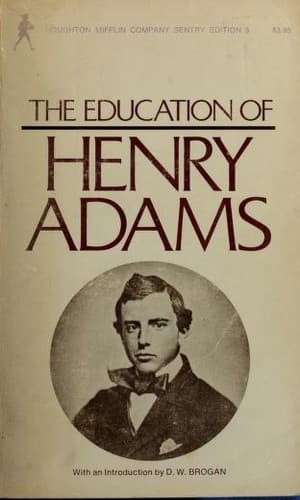
Adams, Henry, 1838-1918; Historians -- United States -- Biography
Thanks to the article on Sir Charles Lyell, Adams passed for a
friend of geologists, and the extent of his knowledge mattered much
less to them than the extent of his friendship, for geologists were as
a class not much better off than himself, and friends were sorely few.
One of his friends from earliest childhood, and nearest neighbor in
Quincy, Frank Emmons, had become a geologist and joined the Fortieth
Parallel Survey under Government. At Washington in the winter of
1869-70, Emmons had invited Adams to go out with him on one of the
field-parties in summer. Of course when Adams took the Review he put it
at the service of the Survey, and regretted only that he could not do
more. When the first year of professing and editing was at last over,
and his July North American appeared, he drew a long breath of relief,
and took the next train for the West. Of his year's work he was no
judge. He had become a small spring in a large mechanism, and his work
counted only in the sum; but he had been treated civilly by everybody,
and he felt at home even in Boston. Putting in his pocket the July
number of the North American, with a notice of the Fortieth Parallel
Survey by Professor J. D. Whitney, he started for the plains and the
Rocky Mountains.
In the year 1871, the West was still fresh, and the Union
Pacific was young. Beyond the Missouri River, one felt the atmosphere
of Indians and buffaloes. One saw the last vestiges of an old
education, worth studying if one would; but it was not that which Adams
sought; rather, he came out to spy upon the land of the future. The
Survey occasionally borrowed troopers from the nearest station in case
of happening on hostile Indians, but otherwise the topographers and
geologists thought more about minerals than about Sioux. They held
under their hammers a thousand miles of mineral country with all its
riddles to solve, and its stores of possible wealth to mark. They felt
the future in their hands.
Emmons's party was out of reach in the Uintahs, but Arnold
Hague's had come in to Laramie for supplies, and they took charge of
Adams for a time. Their wanderings or adventures matter nothing to the
story of education. They were all hardened mountaineers and surveyors
who took everything for granted, and spared each other the most
wearisome bore of English and Scotch life, the stories of the big game
they killed. A bear was an occasional amusement; a wapiti was a
constant necessity; but the only wild animal dangerous to man was a
rattlesnake or a skunk. One shot for amusement, but one had other
matters to talk about.
Public-domain text, read in full here on John Shaqi.
Reviews
Reviews
No reviews yet
Be the first to share your thoughts on this work.
Elsewhere in the archive
Join the Discussion
Join the discussion
Sign in to leave a comment or review.
Sign InorCreate an account