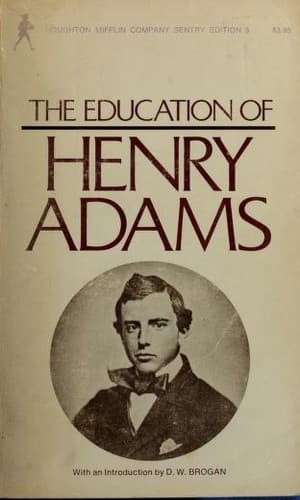
Adams, Henry, 1838-1918; Historians -- United States -- Biography
HARDLY a week passed when the newspapers announced that
President Lincoln had selected Charles Francis Adams as his Minister to
England. Once more, silently, Henry put Blackstone back on its shelf.
As Friar Bacon's head sententiously announced many centuries before:
Time had passed! The Civil Law lasted a brief day; the Common Law
prolonged its shadowy existence for a week. The law, altogether, as
path of education, vanished in April, 1861, leaving a million young men
planted in the mud of a lawless world, to begin a new life without
education at all. They asked few questions, but if they had asked
millions they would have got no answers. No one could help. Looking
back on this moment of crisis, nearly fifty years afterwards, one could
only shake one's white beard in silent horror. Mr. Adams once more
intimated that he thought himself entitled to the services of one of
his sons, and he indicated Henry as the only one who could be spared
from more serious duties. Henry packed his trunk again without a word.
He could offer no protest. Ridiculous as he knew himself about to be in
his new role, he was less ridiculous than his betters. He was at least
no public official, like the thousands of improvised secretaries and
generals who crowded their jealousies and intrigues on the President.
He was not a vulture of carrion--patronage. He knew that his father's
appointment was the result of Governor Seward's personal friendship; he
did not then know that Senator Sumner had opposed it, or the reasons
which Sumner alleged for thinking it unfit; but he could have supplied
proofs enough had Sumner asked for them, the strongest and most
decisive being that, in his opinion, Mr. Adams had chosen a private
secretary far more unfit than his chief. That Mr. Adams was unfit might
well be, since it was hard to find a fit appointment in the list of
possible candidates, except Mr. Sumner himself; and no one knew so well
as this experienced Senator that the weakest of all Mr. Adams's proofs
of fitness was his consent to quit a safe seat in Congress for an
exceedingly unsafe seat in London with no better support than Senator
Sumner, at the head of the Foreign Relations Committee, was likely to
give him. In the family history, its members had taken many a dangerous
risk, but never before had they taken one so desperate.
Public-domain text, read in full here on John Shaqi.
Reviews
Reviews
No reviews yet
Be the first to share your thoughts on this work.
Elsewhere in the archive
Join the Discussion
Join the discussion
Sign in to leave a comment or review.
Sign InorCreate an account