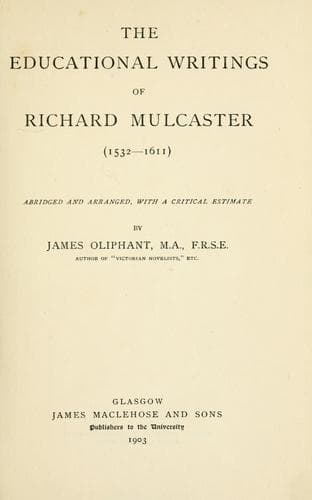
The Educational Writings of Richard MulcasterMulcaster, Richard
History
The Educational Writings of Richard Mulcaster
Mulcaster, Richard
Education -- History
our tongue, whose physicking I like not this way, and therefore I
will join close with my own observation to see if that will help.
Those men who will give any certain direction for the writing of
any tongue, or for anything else that concerns a tongue, must
take some period in its history, or else their rules will prove
inapplicable. For every tongue has a certain ascent from the lowest
to the highest point, and a descent again from the highest to the
lowest; and as in the ascent it has not reached a secure position,
because it is not thoroughly reduced to art, so in the descent it
comes to be not worth noting, because it gets rude again, and in
a manner withered. Hence it comes that the age of Demosthenes is
the prince of Greece, as that of Cicero is the flower of Rome, and
if the languages of these countries had not been committed to the
security of books, they would have been of little worth; nay, they
would have been forgotten altogether, long before our day, as the
spoken tongues of those nations, changing continually since the
periods named, are now quite altered, or at least are nothing like
what they were in their prime, though still blooming in another
form. So that books give life where bodies bring only death.
Consider the Greek and Latin writers before the ages of those men,
and by comparing them with these, you will see the difference that
I spoke of, the earlier being too rude to be brought under rule,
and the later departing from established rules and yielding to
change. This period of full development, with the ascent to it and
the decline leading to decay, shows us that everything belonging
to man is subject to change, the language changing also, but never
dying out. It must needs be therefore that there is something of
the nature of a soul in every spoken tongue that feeds this change
even with perceptible means. For if any tongue be fixed, and free
from movement, it is enshrined in books, not subject to ordinary
use, but made immortal by the register of memory.
Public-domain text, read in full here on John Shaqi.
Reviews
Reviews
No reviews yet
Be the first to share your thoughts on this work.
Elsewhere in the archive
Join the Discussion
Join the discussion
Sign in to leave a comment or review.
Sign InorCreate an account