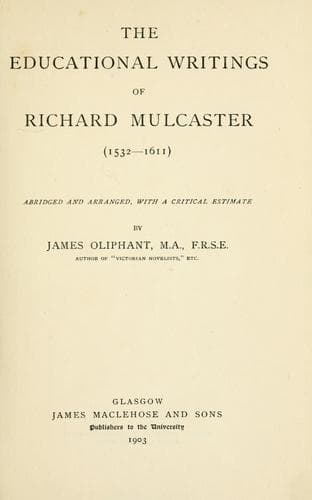
The Educational Writings of Richard MulcasterMulcaster, Richard
History
The Educational Writings of Richard Mulcaster
Mulcaster, Richard
Education -- History
I take this present period of our English tongue to be its very
height, because I find it as excellently refined, both in its
general substance and in its customary writing, as either foreign
workmanship can give it gloss, or home-wrought handling can give
it grace. When the period of our nation which now uses the tongue
so well is dead and departed, another will succeed, and with the
people the tongue will alter. A later period may in its full
harvest prove comparable to the present, but surely this which
we now have seems to be at its best and bravest, and whatever
may become of the English State, the English tongue cannot prove
fairer than it is at this date, if it may please our learned class
to think so of it, and to bestow their labour on a subject so
capable of adornment, and so fitting to themselves. The force of
prerogative is such that it cannot be disobeyed, though it seems to
derange some well-ordered rule, and make people wonder who do not
weigh the cause.
For this reason, when any case arises quite contrary to the common
precept, though not to the common custom, then we must needs think
of the power of prerogative, a great princess in influence, and a
parent to corruption, but intending to raise another Phœnix from
the former ashes. He who refuses to grant such a prerogative to any
tongue, denies it life, unless he means, by registering some period
in it of most excellent note, to restrain prerogative, and preserve
the tongue, which he secures by writing from being profaned by
the people; it becomes then a learned tongue and exempt from
corruption, as our book-languages are, whose rules are so secure
that they dream of no change. This prerogative and liberty which
the nation has, to use both speech and pen at will, is the cause
why English writers are finer now than they were some hundred years
ago, though some antiquary may consider the old writing finer. But
the question is wherein fineness consists. So was Sallust deceived
among the Romans, living with Cicero, and writing like ancient Cato.
In this prerogative of writing, the very pen itself is a great
influence and has marvellous authority, for being the secretary
who carries out what is expressed by the intelligence, it presumes
upon this to venture, as far as any counsellor may, though never
against reason, whose instrument it is to satisfy the eye as the
tongue satisfies the ear. Custom, whose charge prerogative is, as
the pen is his conveyer, favours the pen very greatly and will not
hesitate to maintain that a dash with a pen may hold for a warrant,
when both speed and grace bid the pen be bold. Hence it comes that
in our language so many z’s are heard, and so few seen, owing to
the regard for dexterity and speed in the fluency of writing; and
as the pen can do this, I take it as a matter of prerogative, for
the sake of smoothness, that our tongue uses _z_ so much for _s_.
Public-domain text, read in full here on John Shaqi.
Reviews
Reviews
No reviews yet
Be the first to share your thoughts on this work.
Elsewhere in the archive
Join the Discussion
Join the discussion
Sign in to leave a comment or review.
Sign InorCreate an account