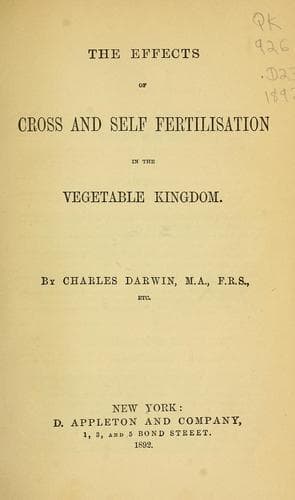
The Effects of Cross & Self-Fertilisation in the Vegetable KingdomDarwin, Charles
Science
The Effects of Cross & Self-Fertilisation in the Vegetable Kingdom
Darwin, Charles
Fertilization of plants; Plants -- Variation; Pollination
Seeds of the same two lots were also sown in two adjoining rows in the
open ground. There were twenty crossed plants in the one row and
thirty-two self-fertilised plants in the other row, so that the
experiment was not quite fair; but not so unfair as it at first appears,
for the plants in the same row were not crowded so much as seriously to
interfere with each other’s growth, and the ground was bare on the
outside of both rows. These plants were better nourished than those in
the pots and grew to a greater height. The eight tallest plants in each
row were measured in the same manner as before, with the following
result:--
TABLE 4/36. Reseda lutea, growing in the open ground.
Heights of plants to the summits of the flower-stems measured in inches.
Column 1: Crossed Plants.
Column 2: Self-fertilised Plants.
28 : 33 2/8.
27 3/8 : 23.
27 5/8 : 21 5/8.
28 6/8 : 20 4/8.
29 7/8 : 21 5/8.
26 6/8 : 22.
26 2/8 : 21 2/8.
30 1/8 : 21 7/8.
Total : 224.75 : 185.13
The average height of the crossed plants, whilst in full flower, was
here 28.09, and that of the self-fertilised 23.14 inches; or as 100 to
82. It is a singular fact that the tallest plant in the two rows, was
one of the self-fertilised. The self-fertilised plants had smaller and
paler green leaves than the crossed. All the plants in the two rows were
afterwards cut down and weighed. The twenty crossed plants weighed 65
ounces, and twenty self-fertilised (by calculation from the actual
weight of the thirty-two self-fertilised plants) weighed 26.25 ounces;
or as 100 to 40. Therefore the crossed plants did not exceed in weight
the self-fertilised plants in nearly so great a degree as those growing
in the pots, owing probably to the latter having been subjected to more
severe mutual competition. On the other hand, they exceeded the
self-fertilised in height in a slightly greater degree.
Reseda odorata.
Plants of the common mignonette were raised from purchased seed, and
several of them were placed under separate nets. Of these some became
loaded with spontaneously self-fertilised capsules; others produced a
few, and others not a single one. It must not be supposed that these
latter plants produced no seed because their stigmas did not receive any
pollen, for they were repeatedly fertilised with pollen from the same
plant with no effect; but they were perfectly fertile with pollen from
any other plant. Spontaneously self-fertilised seeds were saved from one
of the highly self-fertile plants, and other seeds were collected from
the plants growing outside the nets, which had been crossed by the bees.
These seeds after germinating on sand were planted in pairs on the
opposite sides of five pots. The plants were trained up sticks, and
measured to the summits of their leafy stems--the flower-stems not being
included. We here have the result:--
Public-domain text, read in full here on John Shaqi.
Reviews
Reviews
No reviews yet
Be the first to share your thoughts on this work.
Elsewhere in the archive
Join the Discussion
Join the discussion
Sign in to leave a comment or review.
Sign InorCreate an account