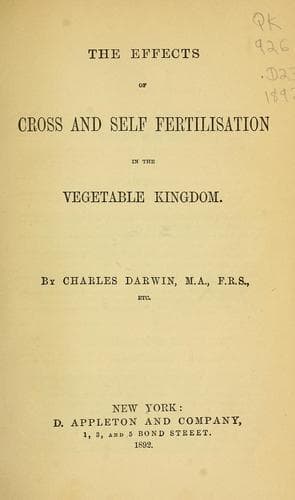
The Effects of Cross & Self-Fertilisation in the Vegetable KingdomDarwin, Charles
Science
The Effects of Cross & Self-Fertilisation in the Vegetable Kingdom
Darwin, Charles
Fertilization of plants; Plants -- Variation; Pollination
The results of my experiments on this plant are hardly worth giving, as
I remark in my notes made at the time, “seedlings, from some unknown
cause, all miserably unhealthy.” Nor did they ever become healthy; yet I
feel bound to give the present case, as it is opposed to the general
results at which I have arrived. Fifteen flowers were crossed and all
produced fruit, containing on an average 32.5 seeds; nineteen flowers
were fertilised with their own pollen, and they likewise all yielded
fruit, containing a rather larger average of 34.5 seeds; or as 100 to
106. Seedlings were raised from these seeds. In one of the pots all the
self-fertilised plants died whilst quite young; in the two others, the
measurements were as follows:
TABLE 4/43. Adonis aestivalis.
Heights of plants measured in inches.
Column 1: Number (Name) of Pot.
Column 2: Crossed Plants.
Column 3: Self-fertilised Plants.
Pot 1 : 14 : 13 4/8.
Pot 1 : 13 4/8 : 13 4/8.
Pot 2 : 16 2/8 : 15 2/8.
Pot 2 : 13 2/8 : 15.
Total : 57.00 : 57.25.
The average height of the four crossed plants is 14.25, and that of the
four self-fertilised plants 14.31; or as 100 to 100.4; so that they were
in fact of equal height. According to Professor H. Hoffman, this plant
is proterandrous (4/7. ‘Zur Speciesfrage’ 1875 page 11.); nevertheless
it yields plenty of seeds when protected from insects.
Delphinium consolida.
It has been said in the case of this plant, as of so many others, that
the flowers are fertilised in the bud, and that distinct plants or
varieties can never naturally intercross. (4/8. Decaisne
‘Comptes-Rendus’ July 1863 page 5.) But this is an error, as we may
infer, firstly from the flowers being proterandrous,--the mature stamens
bending up, one after the other, into the passage which leads to the
nectary, and afterwards the mature pistils bending in the same
direction; secondly, from the number of humble-bees which visit the
flowers (4/9. Their structure is described by H. Muller ‘Befruchtung’
etc., page 122.); and thirdly, from the greater fertility of the flowers
when crossed with pollen from a distinct plant than when spontaneously
self-fertilised. In the year 1863 I enclosed a large branch in a net,
and crossed five flowers with pollen from a distinct plant; these
yielded capsules containing on an average 35.2 very fine seeds, with a
maximum of forty-two in one capsule. Thirty-two other flowers on the
same branch produced twenty-eight spontaneously self-fertilised
capsules, containing on an average 17.2 seeds, with a maximum in one of
thirty-six seeds. But six of these capsules were very poor, yielding
only from one to five seeds; if these are excluded, the remaining
twenty-two capsules give an average of 20.9 seeds, though many of these
seeds were small. The fairest ratio, therefore, for the number of seeds
produced by a cross and by spontaneous self-fertilisation is as 100 to
59. These seeds were not sown, as I had too many other experiments in
progress.
Public-domain text, read in full here on John Shaqi.
Reviews
Reviews
No reviews yet
Be the first to share your thoughts on this work.
Elsewhere in the archive
Join the Discussion
Join the discussion
Sign in to leave a comment or review.
Sign InorCreate an account