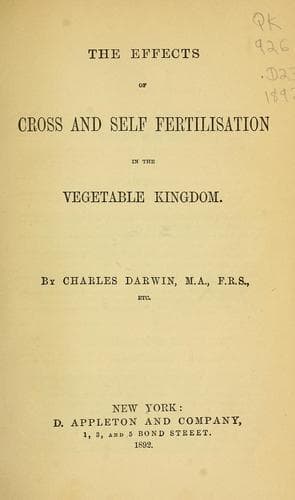
The Effects of Cross & Self-Fertilisation in the Vegetable KingdomDarwin, Charles
Science
The Effects of Cross & Self-Fertilisation in the Vegetable Kingdom
Darwin, Charles
Fertilization of plants; Plants -- Variation; Pollination
The fifteen crossed plants here average 34.5, and the fifteen
self-fertilised 33.55 inches in height; or as 100 to 97. So that the
excess of height of the crossed plants is quite insignificant. In
productiveness, however, the difference was much more plainly marked.
All the capsules were gathered from both lots of plants (except from the
crowded and unproductive ones in Pot 5), and at the close of the season
the few remaining flowers were added in. The fourteen crossed plants
produced 381, whilst the fourteen self-fertilised plants produced only
293 capsules and flowers; or as 100 to 77.
Dianthus caryophyllus.
The common carnation is strongly proterandrous, and therefore depends to
a large extent upon insects for fertilisation. I have seen only
humble-bees visiting the flowers, but I dare say other insects likewise
do so. It is notorious that if pure seed is desired, the greatest care
is necessary to prevent the varieties which grow in the same garden from
intercrossing. (4/10. ‘Gardeners’ Chronicle’ 1847 page 268.) The pollen
is generally shed and lost before the two stigmas in the same flower
diverge and are ready to be fertilised. I was therefore often forced to
use for self-fertilisation pollen from the same plant instead of from
the same flower. But on two occasions, when I attended to this point, I
was not able to detect any marked difference in the number of seeds
produced by these two forms of self-fertilisation.
Several single-flowered carnations were planted in good soil, and were
all covered with a net. Eight flowers were crossed with pollen from a
distinct plant and yielded six capsules, containing on an average 88.6
seeds, with a maximum in one of 112 seeds. Eight other flowers were
self-fertilised in the manner above described, and yielded seven
capsules containing on an average 82 seeds, with a maximum in one of 112
seeds. So that there was very little difference in the number of seeds
produced by cross-fertilisation and self-fertilisation, namely, as 100
to 92. As these plants were covered by a net, they produced
spontaneously only a few capsules containing any seeds, and these few
may perhaps be attributed to the action of Thrips and other minute
insects which haunt the flowers. A large majority of the spontaneously
self-fertilised capsules produced by several plants contained no seeds,
or only a single one. Excluding these latter capsules, I counted the
seeds in eighteen of the finest ones, and these contained on an average
18 seeds. One of the plants was spontaneously self-fertile in a higher
degree than any of the others. On another occasion a single covered-up
plant produced spontaneously eighteen capsules, but only two of these
contained any seed, namely 10 and 15.
CROSSED AND SELF-FERTILISED PLANTS OF THE FIRST GENERATION.
Public-domain text, read in full here on John Shaqi.
Reviews
Reviews
No reviews yet
Be the first to share your thoughts on this work.
Elsewhere in the archive
Join the Discussion
Join the discussion
Sign in to leave a comment or review.
Sign InorCreate an account