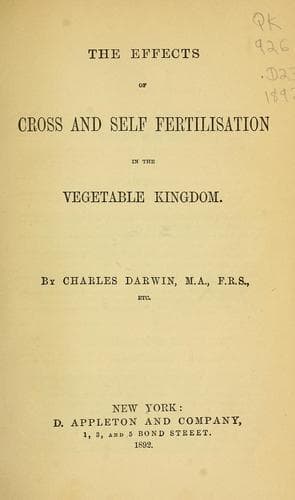
The Effects of Cross & Self-Fertilisation in the Vegetable KingdomDarwin, Charles
Science
The Effects of Cross & Self-Fertilisation in the Vegetable Kingdom
Darwin, Charles
Fertilization of plants; Plants -- Variation; Pollination
These plants were all kept under a net, so that the capsules which they
produced must have been all spontaneously self-fertilised. The eight
crossed plants produced twenty-one such capsules, of which only twelve
contained any seed, averaging 8.5 per capsule. On the other hand, the
eight self-fertilised plants produced no less than thirty-six capsules,
of which I examined twenty-five, and, with the exception of three, all
contained seeds, averaging 10.63 seeds per capsule. Thus the
proportional number of seeds per capsule produced by the plants of
crossed origin to those produced by the plants of self-fertilised origin
(both lots being spontaneously self-fertilised) was as 100 to 125. This
anomalous result is probably due to some of the self-fertilised plants
having varied so as to mature their pollen and stigmas more nearly at
the same time than is proper to the species; and we have already seen
that some plants in the first experiment differed from the others in
being slightly more self-fertile.
THE EFFECTS OF A CROSS WITH A FRESH STOCK.
Twenty flowers on the self-fertilised plants of the last or third
generation, in Table 4/46, were fertilised with their own pollen, but
taken from other flowers on the same plants. These produced fifteen
capsules, which contained (omitting two with only three and six seeds)
on an average 47.23 seeds, with a maximum of seventy in one. The
self-fertilised capsules from the self-fertilised plants of the first
generation yielded the much lower average of 35.95 seeds; but as these
latter plants grew extremely crowded, nothing can be inferred with
respect to this difference in their self-fertility. The seedlings raised
from the above seeds constitute the plants of the fourth self-fertilised
generation in Table 4/47.
Twelve flowers on the same plants of the third self-fertilised
generation, in Table 4/46, were crossed with pollen from the crossed
plants in the same table. These crossed plants had been intercrossed for
the three previous generations; and many of them, no doubt, were more or
less closely inter-related, but not so closely as in some of the
experiments with other species; for several carnation plants had been
raised and crossed in the earlier generations. They were not related, or
only in a distant degree, to the self-fertilised plants. The parents of
both the self-fertilised and crossed plants had been subjected to as
nearly as possible the same conditions during the three previous
generations. The above twelve flowers produced ten capsules, containing
on an average 48.66 seeds, with a maximum in one of seventy-two seeds.
The plants raised from these seeds may be called the INTERCROSSED.
Public-domain text, read in full here on John Shaqi.
Reviews
Reviews
No reviews yet
Be the first to share your thoughts on this work.
Elsewhere in the archive
Join the Discussion
Join the discussion
Sign in to leave a comment or review.
Sign InorCreate an account