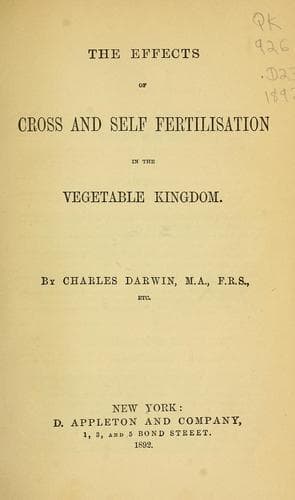
The Effects of Cross & Self-Fertilisation in the Vegetable KingdomDarwin, Charles
Science
The Effects of Cross & Self-Fertilisation in the Vegetable Kingdom
Darwin, Charles
Fertilization of plants; Plants -- Variation; Pollination
The common pea is perfectly fertile when its flowers are protected from
the visits of insects; I ascertained this with two or three different
varieties, as did Dr. Ogle with another. But the flowers are likewise
adapted for cross-fertilisation; Mr. Farrer specifies the following
points, namely: “The open blossom displaying itself in the most
attractive and convenient position for insects; the conspicuous
vexillum; the wings forming an alighting place; the attachment of the
wings to the keel, by which any body pressing on the former must press
down the latter; the staminal tube enclosing nectar, and affording by
means of its partially free stamen with apertures on each side of its
base an open passage to an insect seeking the nectar; the moist and
sticky pollen placed just where it will be swept out of the apex of the
keel against the entering insect; the stiff elastic style so placed that
on a pressure being applied to the keel it will be pushed upwards out of
the keel; the hairs on the style placed on that side of the style only
on which there is space for the pollen, and in such a direction as to
sweep it out; and the stigma so placed as to meet an entering
insect,--all these become correlated parts of one elaborate mechanism,
if we suppose that the fertilisation of these flowers is effected by the
carriage of pollen from one to the other.” (5/12. ‘Nature’ October 10,
1872 page 479. Hermann Muller gives an elaborate description of the
flowers ‘Befruchtung’ etc. page 247.) Notwithstanding these manifest
provisions for cross-fertilisation, varieties which have been cultivated
for very many successive generations in close proximity, although
flowering at the same time, remain pure. I have elsewhere given evidence
on this head, and if required could give more. (5/13. ‘Variation of
Animals and Plants under Domestication’ chapter 9 2nd edition volume 1
page 348.) There can hardly be a doubt that some of Knight’s varieties,
which were originally produced by an artificial cross and were very
vigorous, lasted for at least sixty years, and during all these years
were self-fertilised; for had it been otherwise, they would not have
kept true, as the several varieties are generally grown near together.
Most of the varieties, however, endure for a shorter period; and this
may be in part due to their weakness of constitution from long-continued
self-fertilisation.
Public-domain text, read in full here on John Shaqi.
Reviews
Reviews
No reviews yet
Be the first to share your thoughts on this work.
Elsewhere in the archive
Join the Discussion
Join the discussion
Sign in to leave a comment or review.
Sign InorCreate an account