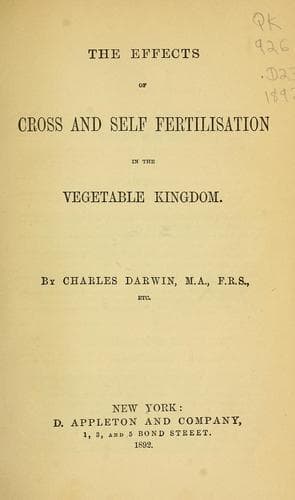
The Effects of Cross & Self-Fertilisation in the Vegetable KingdomDarwin, Charles
Science
The Effects of Cross & Self-Fertilisation in the Vegetable Kingdom
Darwin, Charles
Fertilization of plants; Plants -- Variation; Pollination
Owing to the varieties having been self-fertilised for many generations,
and to their having been subjected in each generation to nearly the same
conditions (as will be explained in a future chapter) I did not expect
that a cross between two such plants would benefit the offspring; and so
it proved on trial. In 1867 I covered up several plants of the Early
Emperor pea, which was not then a very new variety, so that it must
already have been propagated by self-fertilisation for at least a dozen
generations. Some flowers were crossed with pollen from a distinct plant
growing in the same row, and others were allowed to fertilise themselves
under a net. The two lots of seeds thus obtained were sown on opposite
sides of two large pots, but only four pairs came up at the same time.
The pots were kept in the greenhouse. The seedlings of both lots when
between 6 and 7 inches in height were equal. When nearly full-grown they
were measured, as in Table 5/57.
TABLE 5/57. Pisum sativum.
Heights of plants measured in inches.
Column 1: Number (Name) of Pot.
Column 2: Crossed Plants.
Column 3: Self-fertilised Plants.
Pot 1 : 35 : 29 6/8.
Pot 2 : 31 4/8 : 51.
Pot 2 : 35 : 45.
Pot 2 : 37 : 33.
Total : 138.50 : 158.75.
The average height of the four crossed plants is here 34.62, and that of
the four self-fertilised plants 39.68, or as 100 to 115. So that the
crossed plants, far from beating the self-fertilised, were completely
beaten by them.
There can be no doubt that the result would have been widely different,
if any two varieties out of the numberless ones which exist had been
crossed. Notwithstanding that both had been self-fertilised for many
previous generations, each would almost certainly have possessed its own
peculiar constitution; and this degree of differentiation would have
been sufficient to make a cross highly beneficial. I have spoken thus
confidently of the benefit which would have been derived from crossing
any two varieties of the pea from the following facts: Andrew Knight in
speaking of the results of crossing reciprocally very tall and short
varieties, says, “I had in this experiment a striking instance of the
stimulative effects of crossing the breeds; for the smallest variety,
whose height rarely exceeded 2 feet, was increased to 6 feet; whilst the
height of the large and luxuriant kind was very little diminished.”
(5/15. ‘Philosophical Transactions’ 1799 page 200.) Recently Mr. Laxton
has made numerous crosses, and everyone had been astonished at the
vigour and luxuriance of the new varieties which he has thus raised and
afterwards fixed by selection. He gave me seed-peas produced from
crosses between four distinct kinds; and the plants thus raised were
extraordinarily vigorous, being in each case from 1 to 2 or even 3 feet
taller than the parent-forms, which were raised at the same time close
alongside. But as I did not measure their actual height I cannot give
Public-domain text, read in full here on John Shaqi.
Reviews
Reviews
No reviews yet
Be the first to share your thoughts on this work.
Elsewhere in the archive
Join the Discussion
Join the discussion
Sign in to leave a comment or review.
Sign InorCreate an account