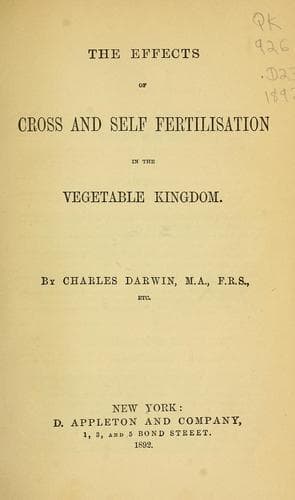
The Effects of Cross & Self-Fertilisation in the Vegetable KingdomDarwin, Charles
Science
The Effects of Cross & Self-Fertilisation in the Vegetable Kingdom
Darwin, Charles
Fertilization of plants; Plants -- Variation; Pollination
Six genera in this family were experimented on, and the results are in
some respects remarkable. The crossed plants of the two species of
Lupinus were conspicuously superior to the self-fertilised plants in
height and fertility; and when grown under very unfavourable conditions,
in vigour. The scarlet-runner (Phaseolus multiflorus) is partially
sterile if the visits of bees are prevented, and there is reason to
believe that varieties growing near one another intercross. The five
crossed plants, however, exceeded in height the five self-fertilised
only by a little. Phaseolus vulgaris is perfectly self-sterile;
nevertheless, varieties growing in the same garden sometimes intercross
largely. The varieties of Lathyrus odoratus, on the other hand, appear
never to intercross in this country; and though the flowers are not
often visited by efficient insects, I cannot account for this fact, more
especially as the varieties are believed to intercross in North Italy.
Plants raised from a cross between two varieties, differing only in the
colour of their flowers, grew much taller and were under unfavourable
conditions more vigorous than the self-fertilised plants; they also
transmitted, when self-fertilised, their superiority to their offspring.
The many varieties of the common Pea (Pisum sativum), though growing in
close proximity, very seldom intercross; and this seems due to the
rarity in this country of the visits of bees sufficiently powerful to
effect cross-fertilisation. A cross between the self-fertilised
individuals of the same variety does no good whatever to the offspring;
whilst a cross between distinct varieties, though closely allied, does
great good, of which we have excellent evidence. The flowers of the
Broom (Sarothamnus) are almost sterile if they are not disturbed and if
insects are excluded. The pollen from a distinct plant is more effective
than that from the same flower in producing seeds. The crossed seedlings
have an enormous advantage over the self-fertilised when grown together
in close competition. Lastly, only four plants of the Ononis minutissima
were raised; but as these were observed during their whole growth, the
advantage of the crossed over the self-fertilised plants may, I think,
be fully trusted.
[15. ONAGRACEAE.--Clarkia elegans.
Owing to the season being very unfavourable (1867), few of the flowers
which I fertilised formed capsules; twelve crossed flowers produced only
four, and eighteen self-fertilised flowers yielded only one capsule. The
seeds after germinating on sand were planted in three pots, but all the
self-fertilised plants died in one of them. When the two lots were
between 4 and 5 inches in height, the crossed began to show a slight
superiority over the self-fertilised. When in full flower they were
measured, with the following result:--
TABLE 5/62. Clarkia elegans.
Heights of plants measured in inches.
Column 1: Number (Name) of Pot.
Column 2: Crossed Plants.
Column 3: Self-fertilised Plants.
Public-domain text, read in full here on John Shaqi.
Reviews
Reviews
No reviews yet
Be the first to share your thoughts on this work.
Elsewhere in the archive
Join the Discussion
Join the discussion
Sign in to leave a comment or review.
Sign InorCreate an account