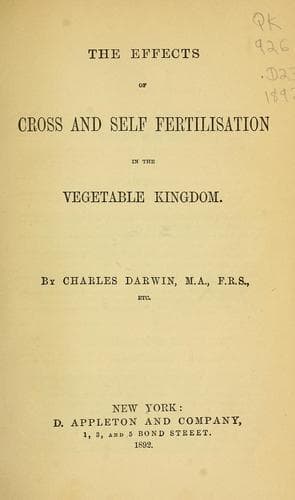
The Effects of Cross & Self-Fertilisation in the Vegetable KingdomDarwin, Charles
Science
The Effects of Cross & Self-Fertilisation in the Vegetable Kingdom
Darwin, Charles
Fertilization of plants; Plants -- Variation; Pollination
This species offers a somewhat perplexing case. In the first generation
the self-fertilised plants, though few in number, greatly exceeded the
crossed in height; whilst in the second generation, when the trial was
made on a much larger scale, the crossed beat the self-fertilised
plants. As this species is generally propagated by off-sets, some
seedlings were first raised, in order to have distinct plants. On one of
these plants several flowers were fertilised with their own pollen; and
as the pollen is mature and shed long before the stigma of the same
flower is ready for fertilisation, it was necessary to number each
flower and keep its pollen in paper with a corresponding number. By this
means well-matured pollen was used for self-fertilisation. Several
flowers on the same plant were crossed with pollen from a distinct
individual, and to obtain this the conjoined anthers of young flowers
were roughly squeezed, and as it is naturally protruded very slowly by
the growth of the pistil, it is probable that the pollen used by me was
hardly mature, certainly less mature than that employed for
self-fertilisation. I did not at the time think of this source of error,
but I now suspect that the growth of the crossed plants was thus
injured. Anyhow the trial was not perfectly fair. Opposed to the belief
that the pollen used in crossing was not in so good a state as that used
for self-fertilisation, is the fact that a greater proportional number
of the crossed than of the self-fertilised flowers produced capsules;
but there was no marked difference in the amount of seed contained in
the capsules of the two lots. (5/24. Gartner has shown that certain
plants of Lobelia fulgens are quite sterile with pollen from the same
plant, though this pollen is efficient on any other individual; but none
of the plants on which I experimented, which were kept in the
greenhouse, were in this peculiar condition.)
As the seeds obtained by the above two methods would not germinate when
left on bare sand, they were sown on the opposite sides of four pots;
but I succeeded in raising only a single pair of seedlings of the same
age in each pot. The self-fertilised seedlings, when only a few inches
in height, were in most of the pots taller than their opponents; and
they flowered so much earlier in all the pots, that the height of the
flower-stems could be fairly compared only in Pots 1 and 2.
TABLE 5/70. Lobelia fulgens (First Generation).
Heights of flower-stems measured in inches.
Column 1: Number (Name) of Pot.
Column 2: Height of Flower-stems on the Crossed Plants.
Column 3: Height of Flower-stems on the Self-fertilised Plants.
Pot 1 : 33 : 50.
Pot 2 : 36 4/8 : 38 4/8.
Pot 3 : 21* : 43.
Pot 4 : 12* : 35 6/8.
*Not in full flower.
Public-domain text, read in full here on John Shaqi.
Reviews
Reviews
No reviews yet
Be the first to share your thoughts on this work.
Elsewhere in the archive
Join the Discussion
Join the discussion
Sign in to leave a comment or review.
Sign InorCreate an account