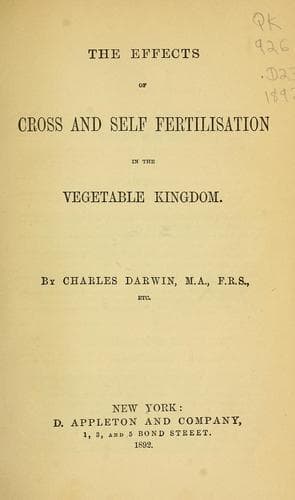
The Effects of Cross & Self-Fertilisation in the Vegetable KingdomDarwin, Charles
Science
The Effects of Cross & Self-Fertilisation in the Vegetable Kingdom
Darwin, Charles
Fertilization of plants; Plants -- Variation; Pollination
The case is rendered the more strange, because the crossed plants in the
fifth pot (not included in the two last tables), in which all the
remaining seeds had been thickly sown, were from the first finer plants
than the self-fertilised, and had larger leaves. At the period when the
two tallest crossed plants in this pot were 6 4/8 and 4 5/8 inches high,
the two tallest self-fertilised were only 4 inches. When the two crossed
plants were 12 and 10 inches high, the two self-fertilised were only 8
inches. These latter plants, as well as many others on the same side of
this pot never grew any higher, whereas several of the crossed plants
grew to the height of two feet! On account of this great superiority of
the crossed plants, the plants on neither side of this pot have been
included in the two last tables.
Thirty flowers on the crossed plants in Pots 1 and 4 (Table 6/79) were
again crossed, and produced seventeen capsules. Thirty flowers on the
self-fertilised plants in the same two pots were again self-fertilised,
but produced only seven capsules. The contents of each capsule of both
lots were placed in separate watch-glasses, and the seeds from the
crossed appeared to the eye to be at least double the number of those
from the self-fertilised capsules.
In order to ascertain whether the fertility of the self-fertilised
plants had been lessened by the plants having been self-fertilised for
the three previous generations, thirty flowers on the crossed plants
were fertilised with their own pollen. These yielded only five capsules,
and their seeds being placed in separate watch-glasses did not seem more
numerous than those from the capsules on the self-fertilised plants
self-fertilised for the fourth time. So that as far as can be judged
from so few capsules, the self-fertility of the self-fertilised plants
had not decreased in comparison with that of the plants which had been
intercrossed during the three previous generations. It should, however,
be remembered that both lots of plants had been subjected in each
generation to almost exactly similar conditions.
Seeds from the crossed plants again crossed, and from the
self-fertilised again self-fertilised, produced by the plants in Pot 1
(Table 6/79), in which the three self-fertilised plants were on an
average only a little taller than the crossed, were used in the
following experiment. They were kept separate from two similar lots of
seeds produced by the two plants in Pot 4 in the same table, in which
the crossed plant was much taller than its self-fertilised opponent.
CROSSED AND SELF-FERTILISED PLANTS OF THE FOURTH GENERATION (RAISED FROM
THE PLANTS IN POT 1, TABLE 6/79).
Public-domain text, read in full here on John Shaqi.
Reviews
Reviews
No reviews yet
Be the first to share your thoughts on this work.
Elsewhere in the archive
Join the Discussion
Join the discussion
Sign in to leave a comment or review.
Sign InorCreate an account