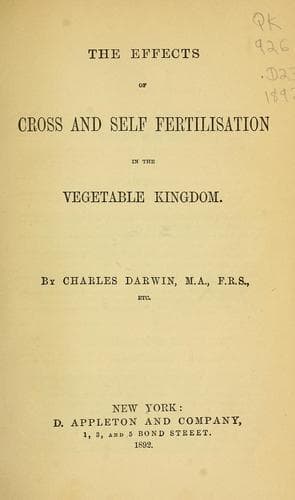
The Effects of Cross & Self-Fertilisation in the Vegetable KingdomDarwin, Charles
Science
The Effects of Cross & Self-Fertilisation in the Vegetable Kingdom
Darwin, Charles
Fertilization of plants; Plants -- Variation; Pollination
The thirteen crossed plants here average 44.74, and the thirteen
self-fertilised plants 26.87 inches in height; or as 100 to 60. The
crossed parents of these were much taller, relatively to the
self-fertilised parents, than in the last case; and apparently they
transmitted some of this superiority to their crossed offspring. It is
unfortunate that I did not turn these plants out of doors, so as to
observe their relative fertility, for I compared the pollen from some of
the crossed and self-fertilised plants in Pot 1, Table 6/81, and there
was a marked difference in its state; that of the crossed plants
contained hardly any bad and empty grains, whilst such abounded in the
pollen of the self-fertilised plants.
THE EFFECTS OF A CROSS WITH A FRESH STOCK.
I procured from a garden in Westerham, whence my plants originally came,
a fresh plant differing in no respect from mine except in the colour of
the flowers, which was a fine purple. But this plant must have been
exposed during at least four generations to very different conditions
from those to which my plants had been subjected, as these had been
grown in pots in the greenhouse. Eight flowers on the self-fertilised
plants in Table 6/81, of the last or fourth self-fertilised generation,
were fertilised with pollen from this fresh stock; all eight produced
capsules containing together by weight 5.01 grains of seeds. The plants
raised from these seeds may be called the Westerham-crossed.
Eight flowers on the crossed plants of the last or fourth generation in
Table 6/81 were again crossed with pollen from one of the other crossed
plants, and produced five capsules, containing by weight 2.07 grains of
seeds. The plants raised from these seeds may be called the
INTERCROSSED; and these form the fifth intercrossed generation.
Eight flowers on the self-fertilised plants of the same generation in
Table 6/81 were again self-fertilised, and produced seven capsules,
containing by weight 2.1 grains of seeds. The SELF-FERTILISED plants
raised from these seeds form the fifth self-fertilised generation. These
latter plants and the intercrossed are comparable in all respects with
the crossed and self-fertilised plants of the four previous generations.
From the foregoing data it is easy to calculate that:
Ten Westerham-crossed capsules would have contained 6.26 grains weight
of seed.
Ten intercrossed capsules would have contained 4.14 grains weight of
seed.
Ten self-fertilised capsules would have contained 3.00 grains weight of
seed.
We thus get the following ratios:--
Seeds from the Westerham-crossed capsules to those from the capsules of
the fifth self-fertilised generation, in weight as 100 to 48.
Seeds from the Westerham-crossed capsules to those from the capsules of
the fifth intercrossed generation, in weight as 100 to 66.
Seeds from the intercrossed capsules to those from the self-fertilised
capsules, in weight as 100 to 72.
Public-domain text, read in full here on John Shaqi.
Reviews
Reviews
No reviews yet
Be the first to share your thoughts on this work.
Elsewhere in the archive
Join the Discussion
Join the discussion
Sign in to leave a comment or review.
Sign InorCreate an account