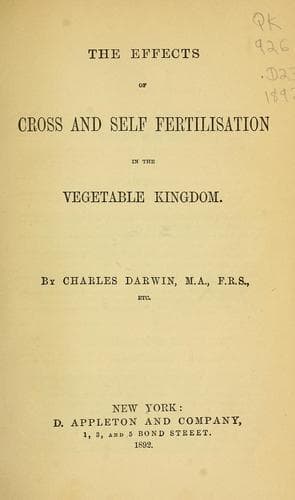
The Effects of Cross & Self-Fertilisation in the Vegetable KingdomDarwin, Charles
Science
The Effects of Cross & Self-Fertilisation in the Vegetable Kingdom
Darwin, Charles
Fertilization of plants; Plants -- Variation; Pollination
Column 1: Number (Name) of Pot.
Column 2: Crossed Plants.
Column 3: Self-fertilised Plants.
Pot 1 : 10 : 0.
Pot 1 : 9 2/8 : 0.
Pot 1 : 10 2/8 : 0.
Pot 2 : 9 2/8 : 0.
Pot 2 : 10 : 0.
Pot 2 : 10 2/8 : 0.
Pot 3 : 9 1/8 : 8.
Pot 3 : 9 5/8 : 6 7/8.
Pot 3 : 9 5/8 : 6 6/8.
Pot 4 : 11 1/8 : 0.
Pot 4 : 10 5/8 : 7 7/8.
Pot 4 : 10 6/8 : 0.
Total : 119.88 : 29.50.
In the following year the crossed plants again bore many flowers before
the self-fertilised bore a single one. The three tallest flower-stems on
the crossed plants in each of the pots were measured, as shown in Table
6/91. In Pots 1 and 2 the self-fertilised plants did not produce a
single flower-stem; in Pot 4 only one; and in Pot 3 six, of which the
three tallest were measured.
The average height of the twelve flower-stems on the crossed plants is
9.99, and that of the four flower-stems on the self-fertilised plants
7.37 inches; or as 100 to 74. The self-fertilised plants were miserable
specimens, whilst the crossed ones looked very vigorous.
ANAGALLIS.
Anagallis collina, var. grandiflora (pale red and blue-flowered
sub-varieties).
Firstly, twenty-five flowers on some plants of the red variety were
crossed with pollen from a distinct plant of the same variety, and
produced ten capsules; thirty-one flowers were fertilised with their own
pollen, and produced eighteen capsules. These plants, which were grown
in pots in the greenhouse, were evidently in a very sterile condition,
and the seeds in both sets of capsules, especially in the
self-fertilised, although numerous, were of so poor a quality that it
was very difficult to determine which were good and which bad. But as
far as I could judge, the crossed capsules contained on an average 6.3
good seeds, with a maximum in one of thirteen; whilst the
self-fertilised contained 6.05 such seeds, with a maximum in one of
fourteen.
Secondly, eleven flowers on the red variety were castrated whilst young
and fertilised with pollen from the blue variety, and this cross
evidently much increased their fertility; for the eleven flowers yielded
seven capsules, which contained on an average twice as many good seeds
as before, namely, 12.7; with a maximum in two of the capsules of
seventeen seeds. Therefore these crossed capsules yielded seeds compared
with those in the foregoing self-fertilised capsules, as 100 to 48.
These seeds were also conspicuously larger than those from the cross
between two individuals of the same red variety, and germinated much
more freely. The flowers on most of the plants produced by the cross
between the two-coloured varieties (of which several were raised), took
after their mother, and were red-coloured. But on two of the plants the
flowers were plainly stained with blue, and to such a degree in one case
as to be almost intermediate in tint.
Public-domain text, read in full here on John Shaqi.
Reviews
Reviews
No reviews yet
Be the first to share your thoughts on this work.
Elsewhere in the archive
Join the Discussion
Join the discussion
Sign in to leave a comment or review.
Sign InorCreate an account