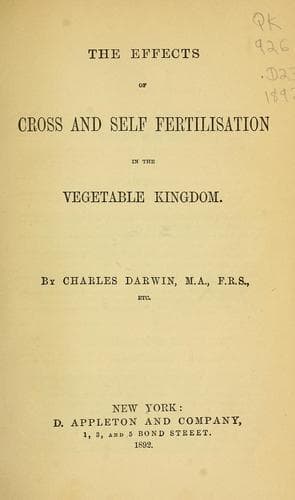
The Effects of Cross & Self-Fertilisation in the Vegetable KingdomDarwin, Charles
Science
The Effects of Cross & Self-Fertilisation in the Vegetable Kingdom
Darwin, Charles
Fertilization of plants; Plants -- Variation; Pollination
According to Delpino, bees eagerly visit the flowers in North Italy, but
I have never seen any insect visiting the flowers of the present species
in my hothouse, although many plants grew there during several years.
Nevertheless these plants produced plenty of seed, as they likewise did
when covered by a net; they are therefore fully capable of
self-fertilisation, and have probably been self-fertilised in this
country for many generations. As they are cultivated in pots, and are
not exposed to competition with surrounding plants, they have also been
subjected for a considerable time to somewhat uniform conditions. This,
therefore, is a case exactly parallel with that of the common pea, in
which we have no right to expect much or any good from intercrossing
plants thus descended and thus treated; and no good did follow,
excepting that the cross-fertilised flowers yielded rather more seeds
than the self-fertilised. This species was one of the earlier ones on
which I experimented, and as I had not then raised any self-fertilised
plants for several successive generations under uniform conditions, I
did not know or even suspect that such treatment would interfere with
the advantages to be gained from a cross. I was therefore much surprised
at the crossed plants not growing more vigorously than the
self-fertilised, and a large number of plants were raised,
notwithstanding that the present species is an extremely troublesome one
to experiment on. The seeds, even those which have been long soaked in
water, will not germinate well on bare sand; and those that were sown in
pots (which plan I was forced to follow) germinated at very unequal
intervals of time; so that it was difficult to get pairs of the same
exact age, and many seedlings had to be pulled up and thrown away. My
experiments were continued during three successive generations; and in
each generation the self-fertilised plants were again self-fertilised,
their early progenitors in this country having probably been
self-fertilised for many previous generations. In each generation, also,
the crossed plants were fertilised with pollen from another crossed
plant.
Public-domain text, read in full here on John Shaqi.
Reviews
Reviews
No reviews yet
Be the first to share your thoughts on this work.
Elsewhere in the archive
Join the Discussion
Join the discussion
Sign in to leave a comment or review.
Sign InorCreate an account