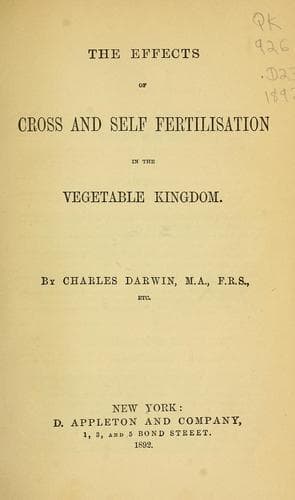
The Effects of Cross & Self-Fertilisation in the Vegetable KingdomDarwin, Charles
Science
The Effects of Cross & Self-Fertilisation in the Vegetable Kingdom
Darwin, Charles
Fertilization of plants; Plants -- Variation; Pollination
In order to raise plants of the third generation, a better plan was
followed, and flowers on the crossed plants of the second generation
were selected in which the stamens were too short to reach the stigmas,
so that they could not possibly have been self-fertilised. These flowers
were crossed with pollen from a distinct plant. Flowers on the
self-fertilised plants of the second generation were again
self-fertilised. From the two lots of seeds thus obtained, twenty-one
crossed and nineteen self-fertilised plants of equal age, and forming
the third generation, were raised in fourteen large pots. They were
measured when fully grown, and by an odd chance the average height of
the two lots was exactly the same, namely, 35.96 inches; so that neither
side had the least advantage over the other. To test this result, all
the plants on both sides in ten out of the above fourteen pots were cut
down after they had flowered, and in the ensuing year the stems were
again measured; and now the crossed plants exceeded by a little (namely,
1.7 inches) the self-fertilised. They were again cut down, and on their
flowering for the third time, the self-fertilised plants had a slight
advantage (namely, 1.54 inches) over the crossed. Hence the result
arrived at with these plants during the previous trials was confirmed,
namely, that neither lot had any decided advantage over the other. It
may, however, be worth mentioning that the self-fertilised plants showed
some tendency to flower before the crossed plants: this occurred with
all three pairs of the first generation; and with the cut down plants of
the third generation, a self-fertilised plant flowered first in nine out
of the twelve pots, whilst in the remaining three pots a crossed plant
flowered first.
If we consider all the plants of the three generations taken together,
the thirty-four crossed plants average 35.98, and the thirty-four
self-fertilised plants 36.39 inches in height; or as 100 to 101. We may
therefore conclude that the two lots possessed equal powers of growth;
and this I believe to be the result of long-continued
self-fertilisation, together with exposure to similar conditions in each
generation, so that all the individuals had acquired a closely similar
constitution.
30. GRAMINACEAE.--Zea mays.
Public-domain text, read in full here on John Shaqi.
Reviews
Reviews
No reviews yet
Be the first to share your thoughts on this work.
Elsewhere in the archive
Join the Discussion
Join the discussion
Sign in to leave a comment or review.
Sign InorCreate an account