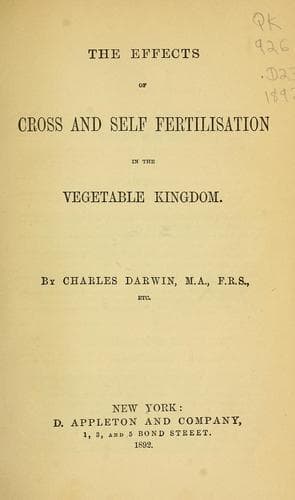
The Effects of Cross & Self-Fertilisation in the Vegetable KingdomDarwin, Charles
Science
The Effects of Cross & Self-Fertilisation in the Vegetable Kingdom
Darwin, Charles
Fertilization of plants; Plants -- Variation; Pollination
Primula veris--(equal-styled, red-flowered variety)--offspring from
plants self-fertilised for two generations and then crossed by a
different variety, compared with plants of the third self-fertilised
generation, in fertility:
.. : .. : .. : .. : 11.
In these three tables the measurements of fifty-seven species, belonging
to fifty-two genera and to thirty great natural families, are given. The
species are natives of various parts of the world. The number of crossed
plants, including those derived from a cross between plants of the same
stock and of two different stocks, amounts to 1,101; and the number of
self-fertilised plants (including a few in Table 7/C derived from a
cross between plants of the same old stock) is 1,076. Their growth was
observed from the germination of the seeds to maturity; and most of them
were measured twice and some thrice. The various precautions taken to
prevent either lot being unduly favoured, have been described in the
introductory chapter. Bearing all these circumstances in mind, it may be
admitted that we have a fair basis for judging of the comparative
effects of cross-fertilisation and of self-fertilisation on the growth
of the offspring.
It will be the most convenient plan first to consider the results given
in Table 7/C, as an opportunity will thus be afforded of incidentally
discussing some important points. If the reader will look down the right
hand column of this table, he will see at a glance what an extraordinary
advantage in height, weight, and fertility the plants derived from a
cross with a fresh stock or with another sub-variety have over the
self-fertilised plants, as well as over the intercrossed plants of the
same old stock. There are only two exceptions to this rule, and these
are hardly real ones. In the case of Eschscholtzia, the advantage is
confined to fertility. In that of Petunia, though the plants derived
from a cross with a fresh stock had an immense superiority in height,
weight, and fertility over the self-fertilised plants, they were
conquered by the intercrossed plants of the same old stock in height and
weight, but not in fertility. It has, however, been shown that the
superiority of these intercrossed plants in height and weight was in all
probability not real; for if the two sets had been allowed to grow for
another month, it is almost certain that those from a cross with the
fresh stock would have been victorious in every way over the
intercrossed plants.
Public-domain text, read in full here on John Shaqi.
Reviews
Reviews
No reviews yet
Be the first to share your thoughts on this work.
Elsewhere in the archive
Join the Discussion
Join the discussion
Sign in to leave a comment or review.
Sign InorCreate an account