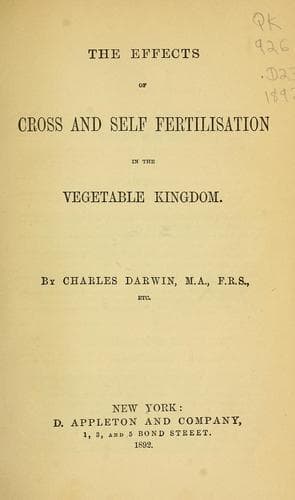
The Effects of Cross & Self-Fertilisation in the Vegetable KingdomDarwin, Charles
Science
The Effects of Cross & Self-Fertilisation in the Vegetable Kingdom
Darwin, Charles
Fertilization of plants; Plants -- Variation; Pollination
Independently of any external cause which could be detected, the
self-fertilised plants were more liable to premature death than were the
crossed; and this seems to me a curious fact. Whilst the seedlings were
very young, if one died its antagonist was pulled up and thrown away,
and I believe that many more of the self-fertilised died at this early
age than of the crossed; but I neglected to keep any record. With Beta
vulgaris, however, it is certain that a large number of the
self-fertilised seeds perished after germinating beneath the ground,
whereas the crossed seeds sown at the same time did not thus suffer.
When a plant died at a somewhat more advanced age the fact was recorded;
and I find in my notes that out of several hundred plants, only seven of
the crossed died, whilst of the self-fertilised at least twenty-nine
were thus lost, that is more than four times as many. Mr. Galton, after
examining some of my tables, remarks: “It is very evident that the
columns with the self-fertilised plants include the larger number of
exceptionally small plants;” and the frequent presence of such puny
plants no doubt stands in close relation with their liability to
premature death. The self-fertilised plants of Petunia completed their
growth and began to wither sooner than did the intercrossed plants; and
these latter considerably before the offspring from a cross with a fresh
stock.
PERIOD OF FLOWERING.
In some cases, as with Digitalis, Dianthus, and Reseda, a larger number
of the crossed than of the self-fertilised plants threw up flower-stems;
but this probably was merely the result of their greater power of
growth; for in the first generation of Lobelia fulgens, in which the
self-fertilised plants greatly exceeded in height the crossed plants,
some of the latter failed to throw up flower-stems. With a large number
of species, the crossed plants exhibited a well-marked tendency to
flower before the self-fertilised ones growing in the same pots. It
should however be remarked that no record was kept of the flowering of
many of the species; and when a record was kept, the flowering of the
first plant in each pot was alone observed, although two or more pairs
grew in the same pot. I will now give three lists,--one of the species
in which the first plant that flowered was a crossed one,--a second in
which the first that flowered was a self-fertilised plant,--and a third
of those which flowered at the same time.
[SPECIES, OF WHICH THE FIRST PLANTS THAT FLOWERED WERE OF CROSSED
PARENTAGE.
Ipomoea purpurea.
I record in my notes that in all ten generations many of the crossed
plants flowered before the self-fertilised; but no details were kept.
Mimulus luteus (First Generation).
Ten flowers on the crossed plants were fully expanded before one on the
self-fertilised.
Mimulus luteus (Second and Third Generation).
In both these generations a crossed plant flowered before one of the
self-fertilised in all three pots.
Public-domain text, read in full here on John Shaqi.
Reviews
Reviews
No reviews yet
Be the first to share your thoughts on this work.
Elsewhere in the archive
Join the Discussion
Join the discussion
Sign in to leave a comment or review.
Sign InorCreate an account