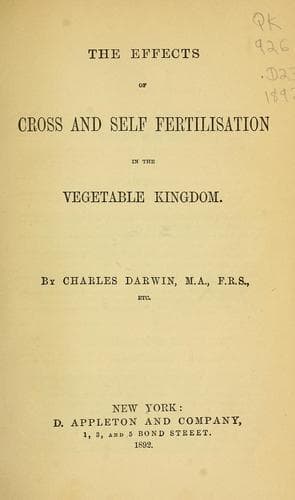
The Effects of Cross & Self-Fertilisation in the Vegetable KingdomDarwin, Charles
Science
The Effects of Cross & Self-Fertilisation in the Vegetable Kingdom
Darwin, Charles
Fertilization of plants; Plants -- Variation; Pollination
The impaired fertility of the self-fertilised plants was shown in
another way, namely, by their anthers being smaller than those in the
flowers on the crossed plants. This was first observed in the seventh
generation, but may have occurred earlier. Several anthers from flowers
on the crossed and self-fertilised plants of the eighth generation were
compared under the microscope; and those from the former were generally
longer and plainly broader than the anthers of the self-fertilised
plants. The quantity of pollen contained in one of the latter was, as
far as could be judged by the eye, about half of that contained in one
from a crossed plant. The impaired fertility of the self-fertilised
plants of the eighth generation was also shown in another manner, which
may often be observed in hybrids--namely, by the first-formed flowers
being sterile. For instance, the fifteen first flowers on a
self-fertilised plant of one of the later generations were carefully
fertilised with their own pollen, and eight of them dropped off; at the
same time fifteen flowers on a crossed plant growing in the same pot
were self-fertilised, and only one dropped off. On two other crossed
plants of the same generation, several of the earliest flowers were
observed to fertilise themselves and to produce capsules. In the plants
of the ninth, and I believe of some previous generations, very many of
the flowers, as already stated, were slightly monstrous; and this
probably was connected with their lessened fertility.
Public-domain text, read in full here on John Shaqi.
Reviews
Reviews
No reviews yet
Be the first to share your thoughts on this work.
Join the Discussion
Join the discussion
Sign in to leave a comment or review.
Sign InorCreate an account