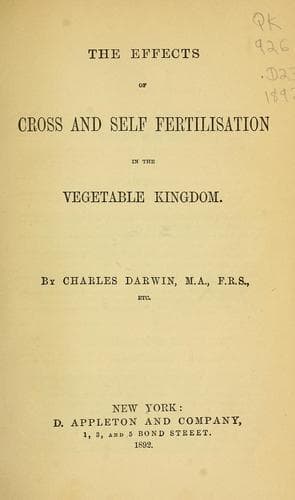
The Effects of Cross & Self-Fertilisation in the Vegetable KingdomDarwin, Charles
Science
The Effects of Cross & Self-Fertilisation in the Vegetable Kingdom
Darwin, Charles
Fertilization of plants; Plants -- Variation; Pollination
All the self-fertilised plants of the seventh generation, and I believe
of one or two previous generations, produced flowers of exactly the same
tint, namely, of a rich dark purple. So did all the plants, without any
exception, in the three succeeding generations of self-fertilised
plants; and very many were raised on account of other experiments in
progress not here recorded. My attention was first called to this fact
by my gardener remarking that there was no occasion to label the
self-fertilised plants, as they could always be known by their colour.
The flowers were as uniform in tint as those of a wild species growing
in a state of nature; whether the same tint occurred, as is probable, in
the earlier generations, neither my gardener nor self could recollect.
The flowers on the plants which were first raised from purchased seed,
as well as during the first few generations, varied much in the depth of
the purple tint; many were more or less pink, and occasionally a white
variety appeared. The crossed plants continued to the tenth generation
to vary in the same manner as before, but to a much less degree, owing,
probably, to their having become more or less closely inter-related. We
must therefore attribute the extraordinary uniformity of colour in the
flowers on the plants of the seventh and succeeding self-fertilised
generations, to inheritance not having been interfered with by crosses
during several preceding generations, in combination with the conditions
of life having been very uniform.
A plant appeared in the sixth self-fertilised generation, named the
Hero, which exceeded by a little in height its crossed antagonist, and
which transmitted its powers of growth and increased self-fertility to
its children and grandchildren. A cross between the children of Hero did
not give to the grandchildren any advantage over the self-fertilised
grandchildren raised from the self-fertilised children. And as far as my
observations can be trusted, which were made on very unhealthy plants,
the great-grandchildren raised from intercrossing the grandchildren had
no advantage over the seedlings from the grandchildren the product of
continued self-fertilisation; and what is far more remarkable, the
great-grandchildren raised by crossing the grandchildren with a fresh
stock, had no advantage over either the intercrossed or self-fertilised
great-grandchildren. It thus appears that Hero and its descendants
differed in constitution in an extraordinary manner from ordinary plants
of the present species.
Public-domain text, read in full here on John Shaqi.
Reviews
Reviews
No reviews yet
Be the first to share your thoughts on this work.
Elsewhere in the archive
Join the Discussion
Join the discussion
Sign in to leave a comment or review.
Sign InorCreate an account