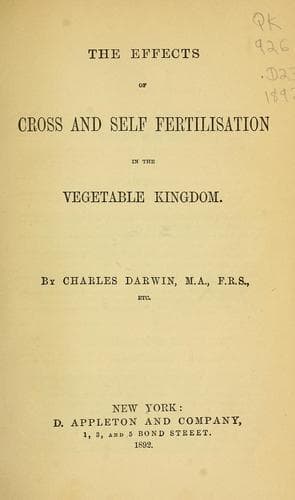
The Effects of Cross & Self-Fertilisation in the Vegetable KingdomDarwin, Charles
Science
The Effects of Cross & Self-Fertilisation in the Vegetable Kingdom
Darwin, Charles
Fertilization of plants; Plants -- Variation; Pollination
The plants which I raised from purchased seed varied greatly in the
colour of their flowers, so that hardly two individuals were quite
alike; the corolla being of all shades of yellow, with the most
diversified blotches of purple, crimson, orange, and coppery brown. But
these plants differed in no other respect. (3/1. I sent several
specimens with variously coloured flowers to Kew, and Dr. Hooker informs
me that they all consisted of Mimulus luteus. The flowers with much red
have been named by horticulturists as var. Youngiana.) The flowers are
evidently well adapted for fertilisation by the agency of insects; and
in the case of a closely allied species, Mimulus rosea, I have watched
bees entering the flowers, thus getting their backs well dusted with
pollen; and when they entered another flower the pollen was licked off
their backs by the two-lipped stigma, the lips of which are irritable
and close like a forceps on the pollen-grains. If no pollen is enclosed
between the lips, these open again after a time. Mr. Kitchener has
ingeniously explained the use of these movements, namely, to prevent the
self-fertilisation of the flower. (3/2. ‘A Year’s Botany’ 1874 page
118.) If a bee with no pollen on its back enters a flower it touches the
stigma, which quickly closes, and when the bee retires dusted with
pollen, it can leave none on the stigma of the same flower. But as soon
as it enters any other flower, plenty of pollen is left on the stigma,
which will be thus cross-fertilised. Nevertheless, if insects are
excluded, the flowers fertilise themselves perfectly and produce plenty
of seed; but I did not ascertain whether this is effected by the stamens
increasing in length with advancing age, or by the bending down of the
pistil. The chief interest in my experiments on the present species,
lies in the appearance in the fourth self-fertilised generation of a
variety which bore large peculiarly-coloured flowers, and grew to a
greater height than the other varieties; it likewise became more highly
self-fertile, so that this variety resembles the plant named Hero, which
appeared in the sixth self-fertilised generation of Ipomoea.
Some flowers on one of the plants raised from the purchased seeds were
fertilised with their own pollen; and others on the same plant were
crossed with pollen from a distinct plant. The seeds from twelve
capsules thus produced were placed in separate watch-glasses for
comparison; and those from the six crossed capsules appeared to the eye
hardly more numerous than those from the six self-fertilised capsules.
But when the seeds were weighed, those from the crossed capsules
amounted to 1.02 grain, whilst those from the self-fertilised capsules
were only .81 grain; so that the former were either heavier or more
numerous than the latter, in the ratio of 100 to 79.
CROSSED AND SELF-FERTILISED PLANTS OF THE FIRST GENERATION.
Public-domain text, read in full here on John Shaqi.
Reviews
Reviews
No reviews yet
Be the first to share your thoughts on this work.
Elsewhere in the archive
Join the Discussion
Join the discussion
Sign in to leave a comment or review.
Sign InorCreate an account