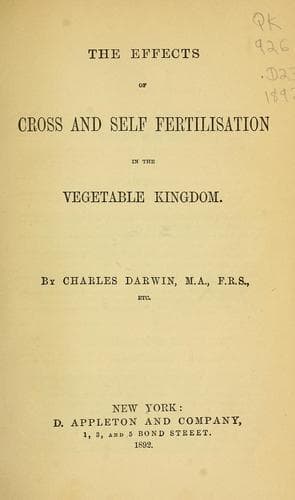
The Effects of Cross & Self-Fertilisation in the Vegetable KingdomDarwin, Charles
Science
The Effects of Cross & Self-Fertilisation in the Vegetable Kingdom
Darwin, Charles
Fertilization of plants; Plants -- Variation; Pollination
Although the plants raised during ten successive generations from
crosses between distinct yet inter-related plants almost invariably
exceeded in height, constitutional vigour, and fertility their
self-fertilised opponents, it has been proved that seedlings raised by
intercrossing flowers on the same plant are by no means superior, on the
contrary are somewhat inferior in height and weight, to seedlings raised
from flowers fertilised with their own pollen. This is a remarkable
fact, which seems to indicate that self-fertilisation is in some manner
more advantageous than crossing, unless the cross brings with it, as is
generally the case, some decided and preponderant advantage; but to this
subject I shall recur in a future chapter.
The benefits which so generally follow from a cross between two plants
apparently depend on the two differing somewhat in constitution or
character. This is shown by the seedlings from the intercrossed plants
of the ninth generation, when crossed with pollen from a fresh stock,
being as superior in height and almost as superior in fertility to the
again intercrossed plants, as these latter were to seedlings from
self-fertilised plants of the corresponding generation. We thus learn
the important fact that the mere act of crossing two distinct plants,
which are in some degree inter-related and which have been long
subjected to nearly the same conditions, does little good as compared
with that from a cross between plants belonging to different stocks or
families, and which have been subjected to somewhat different
conditions. We may attribute the good derived from the crossing of the
intercrossed plants during the ten successive generations to their still
differing somewhat in constitution or character, as was indeed proved by
their flowers still differing somewhat in colour. But the several
conclusions which may be deduced from the experiments on Ipomoea will be
more fully considered in the final chapters, after all my other
observations have been given.
CHAPTER III.
SCROPHULARIACEAE, GESNERIACEAE, LABIATAE, ETC.
Mimulus luteus; height, vigour, and fertility of the crossed and
self-fertilised plants of the first four generations.
Appearance of a new, tall, and highly self-fertile variety.
Offspring from a cross between self-fertilised plants.
Effects of a cross with a fresh stock.
Effects of crossing flowers on the same plant.
Summary on Mimulus luteus.
Digitalis purpurea, superiority of the crossed plants.
Effects of crossing flowers on the same plant.
Calceolaria.
Linaria vulgaris.
Verbascum thapsus.
Vandellia nummularifolia.
Cleistogene flowers.
Gesneria pendulina.
Salvia coccinea.
Origanum vulgare, great increase of the crossed plants by stolons.
Thunbergia alata.
In the family of the Scrophulariaceae I experimented on species in the
six following genera: Mimulus, Digitalis, Calceolaria, Linaria,
Verbascum, and Vandellia.
[3/2. SCROPHULARIACEAE.--Mimulus luteus.
Public-domain text, read in full here on John Shaqi.
Reviews
Reviews
No reviews yet
Be the first to share your thoughts on this work.
Elsewhere in the archive
Join the Discussion
Join the discussion
Sign in to leave a comment or review.
Sign InorCreate an account