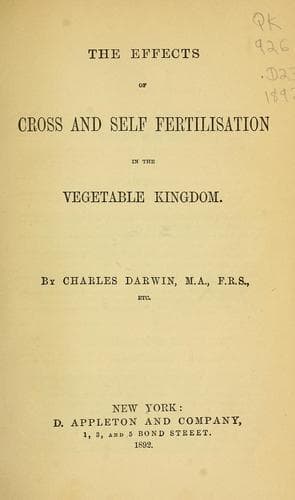
The Effects of Cross & Self-Fertilisation in the Vegetable KingdomDarwin, Charles
Science
The Effects of Cross & Self-Fertilisation in the Vegetable Kingdom
Darwin, Charles
Fertilization of plants; Plants -- Variation; Pollination
Seeds from both lots of the fourth generation, fertilised in the usual
manner, were sown on opposite sides of three pots. When the seedlings
flowered, most of the self-fertilised plants were found to consist of
the tall white variety. Several of the crossed plants in Pot 1 likewise
belonged to this variety, as did a very few in Pots 2 and 3. The tallest
crossed plant in Pot 1 was 7 inches, and the tallest self-fertilised
plant on the opposite side 8 inches; in Pots 2 and 3 the tallest crossed
were 4 1/2 and 5 1/2, and the tallest self-fertilised 7 and 6 1/2 inches
in height; so that the average height of the tallest plants in the two
lots was as 100 for the crossed to 126 for the self-fertilised; and thus
we have a complete reversal of what occurred in the four previous
generations. Nevertheless, in all three pots the crossed plants retained
their habit of flowering before the self-fertilised. The plants were
unhealthy from being crowded and from the extreme heat of the season,
and were in consequence more or less sterile; but the crossed plants
were somewhat less sterile than the self-fertilised plants.
CROSSED AND SELF-FERTILISED PLANTS OF THE SIXTH GENERATION.
Seeds from plants of the fifth generation crossed and self-fertilised in
the usual manner were sown on opposite sides of several pots. On the
self-fertilised side every single plant belonged to the tall white
variety. On the crossed side some plants belonged to this variety, but
the greater number approached in character to the old and shorter kinds
with smaller yellowish flowers blotched with coppery brown. When the
plants on both sides were from 2 to 3 inches in height they were equal,
but when fully grown the self-fertilised were decidedly the tallest and
finest plants, but, from want of time, they were not actually measured.
In half the pots the first plant which flowered was a self-fertilised
one, and in the other half a crossed one. And now another remarkable
change was clearly perceived, namely, that the self-fertilised plants
had become more self-fertile than the crossed. The pots were all put
under a net to exclude insects, and the crossed plants produced
spontaneously only fifty-five capsules, whilst the self-fertilised
plants produced eighty-one capsules, or as 100 to 147. The seeds from
nine capsules of both lots were placed in separate watch-glasses for
comparison, and the self-fertilised appeared rather the more numerous.
Besides these spontaneously self-fertilised capsules, twenty flowers on
the crossed plants again crossed yielded sixteen capsules; twenty-five
flowers on the self-fertilised plants again self-fertilised yielded
seventeen capsules, and this is a larger proportional number of capsules
than was produced by the self-fertilised flowers on the self-fertilised
plants in the previous generations. The contents of ten capsules of both
these lots were compared in separate watch-glasses, and the seeds from
Public-domain text, read in full here on John Shaqi.
Reviews
Reviews
No reviews yet
Be the first to share your thoughts on this work.
Elsewhere in the archive
Join the Discussion
Join the discussion
Sign in to leave a comment or review.
Sign InorCreate an account