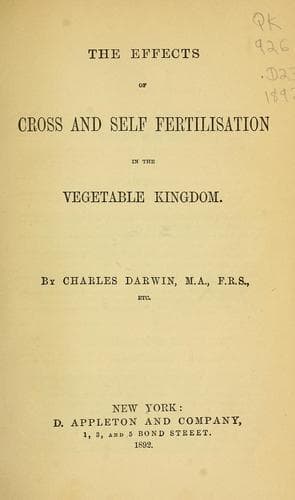
The Effects of Cross & Self-Fertilisation in the Vegetable KingdomDarwin, Charles
Science
The Effects of Cross & Self-Fertilisation in the Vegetable Kingdom
Darwin, Charles
Fertilization of plants; Plants -- Variation; Pollination
This variety transmitted its characters so faithfully to all the
succeeding self-fertilised generations, up to the last or ninth, that
all the many plants which were raised presented a complete uniformity of
character; thus offering a remarkable contrast with the seedlings raised
from the purchased seeds. Yet this variety retained to the last a latent
tendency to produce yellow flowers; for when a plant of the eighth
self-fertilised generation was crossed with pollen from a
yellow-flowered plant of the Chelsea stock, every single seedling bore
yellow flowers. A similar variety, at least in the colour of its
flowers, also appeared amongst the crossed plants of the third
generation. No attention was at first paid to it, and I know not how far
it was at first used either for crossing or self-fertilisation. In the
fifth generation most of the self-fertilised plants, and in the sixth
and all the succeeding generations every single plant consisted of this
variety; and this no doubt was partly due to its great and increasing
self-fertility. On the other hand, it disappeared from amongst the
crossed plants in the later generations; and this was probably due to
the continued intercrossing of the several plants. From the tallness of
this variety, the self-fertilised plants exceeded the crossed plants in
height in all the generations from the fifth to the seventh inclusive;
and no doubt would have done so in the later generations, had they been
grown in competition with one another. In the fifth generation the
crossed plants were in height to the self-fertilised, as 100 to 126; in
the sixth, as 100 to 147; and in the seventh generation, as 100 to 137.
This excess of height may be attributed not only to this variety
naturally growing taller than the other plants, but to its possessing a
peculiar constitution, so that it did not suffer from continued
self-fertilisation.
This variety presents a strikingly analogous case to that of the plant
called the Hero, which appeared in the sixth self-fertilised generation
of Ipomoea. If the seeds produced by Hero had been as greatly in excess
of those produced by the other plants, as was the case with Mimulus, and
if all the seeds had been mingled together, the offspring of Hero would
have increased to the entire exclusion of the ordinary plants in the
later self-fertilised generations, and from naturally growing taller
would have exceeded the crossed plants in height in each succeeding
generation.
Public-domain text, read in full here on John Shaqi.
Reviews
Reviews
No reviews yet
Be the first to share your thoughts on this work.
Elsewhere in the archive
Join the Discussion
Join the discussion
Sign in to leave a comment or review.
Sign InorCreate an account