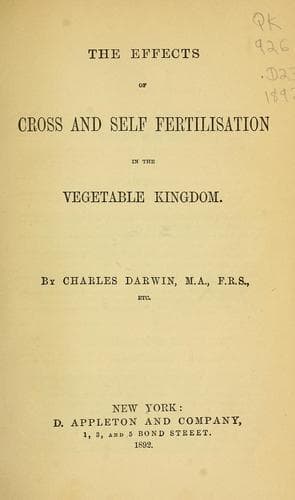
The Effects of Cross & Self-Fertilisation in the Vegetable KingdomDarwin, Charles
Science
The Effects of Cross & Self-Fertilisation in the Vegetable Kingdom
Darwin, Charles
Fertilization of plants; Plants -- Variation; Pollination
I determined to compare again the growth of plants raised from crossed
and self-fertilised perfect flowers, and obtained two fresh lots of
seeds. These were sown on opposite sides of five pots, but they were not
sufficiently thinned, so that they grew rather crowded. When fully
grown, all those above 2 inches in height were selected, all below this
standard being rejected; the former consisted of forty-seven crossed and
forty-one self-fertilised plants; thus a greater number of the crossed
than of the self-fertilised plants grew to a height of above 2 inches.
Of the crossed plants, the twenty-four tallest were on an average 3.6
inches in height; whilst the twenty-four tallest self-fertilised plants
were 3.38 inches in average height; or as 100 to 94. All these plants
were then cut down close to the ground, and the forty-seven crossed
plants weighed 1090.3 grains, and the forty-one self-fertilised plants
weighed 887.4 grains. Therefore an equal number of crossed and
self-fertilised would have been to each other in weight as 100 to 97.
From these several facts we may conclude that the crossed plants had
some real, though very slight, advantage in height and weight over the
self-fertilised plants, when grown in competition with one another.
The crossed plants were, however, inferior in fertility to the
self-fertilised. Six of the finest plants were selected out of the
forty-seven crossed plants, and six out of the forty-one self-fertilised
plants; and the former produced 598 capsules, whilst the latter or
self-fertilised plants produced 752 capsules. All these capsules were
the product of cleistogene flowers, for the plants did not bear during
the whole of this season any perfect flowers. The seeds were counted in
ten cleistogene capsules produced by crossed plants, and their average
number was 46.4 per capsule; whilst the number in ten cleistogene
capsules produced by the self-fertilised plants was 49.4; or as 100 to
106.
3. GESNERIACEAE.--Gesneria pendulina.
In Gesneria the several parts of the flower are arranged on nearly the
same plan as in Digitalis, and most or all of the species are
dichogamous. (3/11. Dr. Ogle ‘Popular Science Review’ January 1870 page
51.) Plants were raised from seed sent me by Fritz Muller from South
Brazil. Seven flowers were crossed with pollen from a distinct plant,
and produced seven capsules containing by weight 3.01 grains of seeds.
Seven flowers on the same plants were fertilised with their own pollen,
and their seven capsules contained exactly the same weight of seeds.
Germinating seeds were planted on opposite sides of four pots, and when
fully grown measured to the tips of their leaves.
TABLE 3/26. Gesneria pendulina.
Heights of Plants measured in inches.
Column 1: Number (Name) of Pot.
Column 2: Crossed Plants.
Column 3: Self-fertilised Plants.
Pot 1 : 42 2/8 : 39.
Pot 1 : 24 4/8 : 27 3/8.
Pot 2 : 33 : 30 6/8.
Pot 2 : 27 : 19 2/8.
Public-domain text, read in full here on John Shaqi.
Reviews
Reviews
No reviews yet
Be the first to share your thoughts on this work.
Elsewhere in the archive
Join the Discussion
Join the discussion
Sign in to leave a comment or review.
Sign InorCreate an account