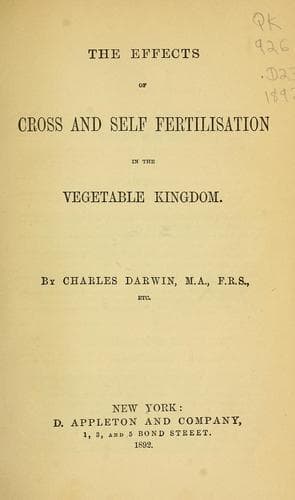
The Effects of Cross & Self-Fertilisation in the Vegetable KingdomDarwin, Charles
Science
The Effects of Cross & Self-Fertilisation in the Vegetable Kingdom
Darwin, Charles
Fertilization of plants; Plants -- Variation; Pollination
This variety produced plenty of spontaneously self-fertilised seed under
a net. Other plants in pots in the greenhouse were left uncovered, and
as I saw small flies visiting the flowers, it seemed probable that they
would be intercrossed. Consequently seeds supposed to have been thus
crossed and spontaneously self-fertilised seeds were sown on opposite
sides of a pot. The self-fertilised seedlings grew from the first
quicker than the supposed crossed seedlings, and when both lots were in
full flower the former were from 5 to 6 inches higher than the crossed!
I record in my notes that the self-fertilised seeds from which these
self-fertilised plants were raised were not so well ripened as the
crossed; and this may possibly have caused the great difference in their
growth, in a somewhat analogous manner as occurred with the
self-fertilised plants of the eighth generation of Ipomoea raised from
unhealthy parents. It is a curious circumstance, that two other lots of
the above seeds were sown in pure sand mixed with burnt earth, and
therefore without any organic matter; and here the supposed crossed
seedlings grew to double the height of the self-fertilised, before both
lots died, as necessarily occurred at an early period. We shall
hereafter meet with another case apparently analogous to this of Iberis
in the third generation of Petunia.
The above self-fertilised plants were allowed to fertilise themselves
again under a net, yielding self-fertilised plants of the second
generation, and the supposed crossed plants were crossed by pollen of a
distinct plant; but from want of time this was done in a careless
manner, namely, by smearing one head of expanded flowers over another. I
should have thought that this would have succeeded, and perhaps it did
so; but the fact of 108 of the self-fertilised seeds weighing 4.87
grains, whilst the same number of the supposed crossed seeds weighed
only 3.57 grains, does not look like it. Five seedlings from each lot of
seeds were raised, and the self-fertilised plants, when fully grown,
exceeded in average height by a trifle (namely .4 of an inch) the five
probably crossed plants. I have thought it right to give this case and
the last, because had the supposed crossed plants proved superior to the
self-fertilised in height, I should have assumed without doubt that the
former had really been crossed. As it is, I do not know what to
conclude.
Public-domain text, read in full here on John Shaqi.
Reviews
Reviews
No reviews yet
Be the first to share your thoughts on this work.
Elsewhere in the archive
Join the Discussion
Join the discussion
Sign in to leave a comment or review.
Sign InorCreate an account