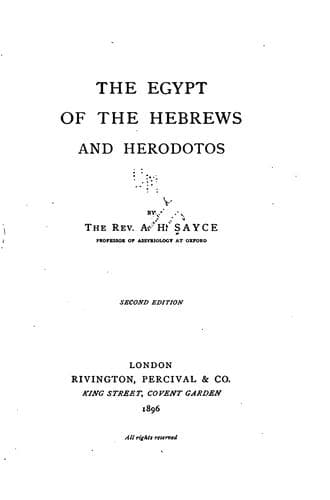
The Egypt of the Hebrews and HerodotosSayce, A. H. (Archibald Henry)
History
The Egypt of the Hebrews and Herodotos
Sayce, A. H. (Archibald Henry)
Egypt -- History, Ancient
The strange error he twice commits in imagining that there were vaults
under the pyramid of Kheops in an island formed by a canal which the
builder had introduced from the Nile is due to the same cause. Doubtless
his dragoman had told him something of the kind. A subterraneous chamber
in the rock actually exists under the great pyramid, as was discovered by
Caviglia, and there are pyramids into whose lower chambers the Nile has
long since infiltrated. Professor Maspero found his exploration of the
pyramids of Lisht, south of Dahshûr, stopped by the water which had filled
them, and Professor Petrie had the same experience in the brick pyramid of
Howâra, though here the infiltration of the water seems to have been
caused by a canal dug in Arab times. But the pyramids of Gizeh stand on a
plateau of limestone rock secure against the approach of water, and the
story reported by Herodotos is more probably the result of misapprehension
on his own part than of intentional falsehood on the part of his guides.
His ready credence of it, however, can be explained only by the condition
of the country at the time of his visit. The whole land was covered with
water, and in going to Memphis he had to sail by the pyramids themselves.
It was in a boat that his visit to them must have been made; and it was
easy, therefore, to believe that a canal ran from the water on which he
sailed through the tunnelled rock whereon they stood. He did not know that
the lowest chamber of the pyramid was high above the utmost level of the
flood.
Surprise has often been expressed that Herodotos should make no mention of
the Sphinx, which to Arabs and modern Europeans alike has appeared one of
most noteworthy monuments of Gizeh. But in sailing along the canal which
led from Memphis to the pyramids he would have passed by it without
notice. As his boat made its way to the rocky edge on which the huge
sepulchres of Kheops and Khephren are built, it would have been concealed
from his view; and buried as it was in sand his guides did not think it an
object of such surpassing importance as to lead him to it over the burning
sand. In the immediate neighbourhood of the great pyramid he was
surrounded by monuments more interesting and more striking, which were
quite enough to occupy his day and satisfy his curiosity.
Public-domain text, read in full here on John Shaqi.
Reviews
Reviews
No reviews yet
Be the first to share your thoughts on this work.
Elsewhere in the archive
Join the Discussion
Join the discussion
Sign in to leave a comment or review.
Sign InorCreate an account