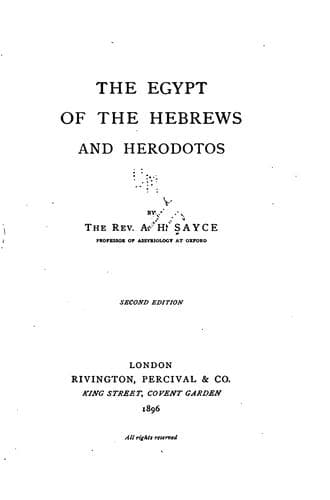
The Egypt of the Hebrews and HerodotosSayce, A. H. (Archibald Henry)
History
The Egypt of the Hebrews and Herodotos
Sayce, A. H. (Archibald Henry)
Egypt -- History, Ancient
Though the journey from Alexandria to Abukîr must now be undertaken in a
railway carriage and not in a barge, it is still pleasant in the early
autumn. We pass through fertile gardens and forests of fig-trees, past
groves of palm with rich clusters of red dates hanging from them, while
the cool sea-breeze blows in at the window, and the clear blue sky shines
overhead. But instead of temples and taverns we find at the end of our
journey nothing but sand and sea-shells, broken monuments, and a deserted
shore.
The vessel in which Herodotos must have gone from Kanôpos to Naukratis was
probably native rather than Greek. It would have differed in one important
respect from the Nile-boats of to-day. Its sail was square, not triangular
like the modern lateen sails which have been introduced from the Levant.
But in other respects it resembled the vessels which are still used on the
Nile. Part of the deck was covered with the house in which the traveller
lived, and which was divided into rooms, and fitted up in accordance with
the ideas of the day. Awnings protected it from the sun, and the sides of
the boat as well as the rudder were brilliantly painted.
On the way to Naukratis the voyager passed Hermopolis, the modern
Damanhur, a name which is merely the old Egyptian _Dema n Hor_, or “City
of Horus.” It is not surprising, therefore, that Herodotos refers to the
city, though the statement he makes in regard to it is not altogether
correct. All the dead ibises of Egypt, he says, were carried to Hermopolis
to be embalmed and buried. Such might have been the case on the western
side of the Delta, but it was true only of that limited district. There
was another Hermopolis in the east of the Delta, called Bah in ancient
Egyptian, Tel el-Baqlîyeh in modern times, where a large burial-place of
the sacred ibises was discovered by the _fellahin_ six or seven years ago.
Tel el-Baqlîyeh is the second station on the line of railway from Mansurah
to Abu Kebîr, and from it have come the bronze ibises and ibis-heads which
have filled the shops of the Cairene dealers in antiquities. The bronzes
were found among the multitudinous mummies of the sacred bird, like the
bronze cats in the cemetery of the sacred cat at Bubastis. Bah was, in
fact, the holy city of the “nome of the Ibis.” The mound of the old city
has now been almost demolished by the hunter for _antikas_, but Dr.
Naville noticed some fragments of inscribed stone in the neighbouring
village which led him to believe that Nektanebo II. once intended to erect
a temple here to Thoth.
Public-domain text, read in full here on John Shaqi.
Reviews
Reviews
No reviews yet
Be the first to share your thoughts on this work.
Elsewhere in the archive
Join the Discussion
Join the discussion
Sign in to leave a comment or review.
Sign InorCreate an account