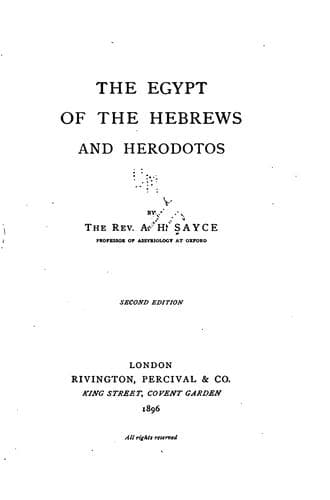
The Egypt of the Hebrews and HerodotosSayce, A. H. (Archibald Henry)
History
The Egypt of the Hebrews and Herodotos
Sayce, A. H. (Archibald Henry)
Egypt -- History, Ancient
Not far from Pelusium another tragedy took place four centuries after
Herodotos had been there. The fugitive Pompey was welcomed to the shore by
Septimius, the general of the Roman forces in Egypt, and Akhillas, the
commander of the Egyptian army, and murdered by them as he touched the
land. Akhillas then hastened to Alexandria, to besiege Cæsar in the royal
palace, and the burning of the great library was the atonement for
Pompey’s death.
Down even to the middle ages Pelusium was still the seaport of the eastern
Delta. It held the place now occupied by Port Said. It was from its quays
that the vessels started for the Syrian coast. In one that was bound for
Tyre, Herodotos took his passage and ended his Egyptian tour.
But he had visited certain cities in the Delta into which we have been
unable to follow him, owing to the uncertainty that still hangs over their
exact position. Besides the places already described, we know that he saw
Butô, which is coupled with Khemmis, as well as Paprêmis and Prosôpitis,
and probably also Busiris.
Khemmis—which must be carefully distinguished from the other Khemmis, the
modern Ekhmîm—was, he tells us, a floating island “in a deep broad lake by
the side of the temple at Butô,” where Lêtô, the Egyptian Uaz, was
worshipped. Brugsch identifies this island of Khemmis with the town and
marshes of Kheb, where the young Horus was hidden by his mother Isis out
of the reach of Set. Kheb was in the nome called that of Menelaos by the
Greeks, the capital of which seems to have been Pa-Uaz, “the temple of
Uaz,” transformed by Greek tongues into Butô, and of which another city
was Kanôpos. Butô, or at least the twin-city where the great temple of the
goddess stood, is probably now represented by Tel Fera’în, not far to the
west of Fuah, at the extremity of the Mahmudîyeh canal. It was thus within
easy distance of Kanôpos on the one side and of Sais on the other, and
Herodotos might have visited it from either one of them.
But after all it is not certain that he did so. Butô is mentioned again by
him in a passage which shows that it could not have been Pa-Uaz, but must
have rather lain on the eastern side of the Delta, in the land of Goshen,
where the desert adjoined the “Arabian nome.” It is where he tells us
about “the winged serpents” which fly in the spring-time from Arabia to
Egypt, on the confines of which they are met and slain by the sacred
ibises. Anxious to learn something about them, he visited the spot where
the yearly encounter took place, and there saw the ground strewn with the
bones and spines of the slaughtered snakes. This spot, he further informs
us, is in the Arabian desert, where it borders on “the Egyptian plain,”
“hard by the city of Buto.”
Public-domain text, read in full here on John Shaqi.
Reviews
Reviews
No reviews yet
Be the first to share your thoughts on this work.
Elsewhere in the archive
Join the Discussion
Join the discussion
Sign in to leave a comment or review.
Sign InorCreate an account