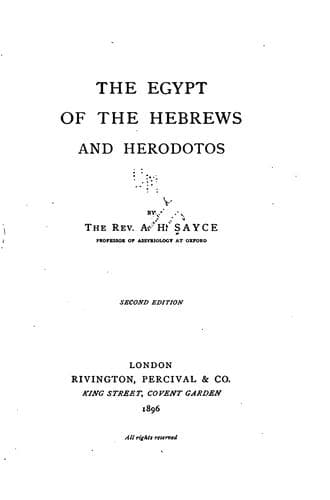
The Egypt of the Hebrews and HerodotosSayce, A. H. (Archibald Henry)
History
The Egypt of the Hebrews and Herodotos
Sayce, A. H. (Archibald Henry)
Egypt -- History, Ancient
It was part of the punishment of Mykerinos that he should lose his
daughter, and the dragomen thus managed to connect the pyramid at Gizeh
with a gilded wooden image of a cow in the palace at Sais, which, since
the reign of Psammetikhos, must have been well-known to them. The cow,
which was really a symbol of Neit in the form of Hathor, with what
Herodotos supposed to be the disk of the sun between its horns, though it
was really the moon, was imagined to be hollow, and to be the coffin of
the daughter of the Pharaoh. The wooden figures which stood beside it were
further imagined to represent the concubines of the king. There were,
however, other stories about both the figures and the cow, less reputable
to the royal character, but equally showing how entirely ignorant
Herodotos’s informants were of Egyptian religion and custom. Though they
knew that at the festival of Osiris the cow was carried out into the open
air, they said this was because the daughter of Mykerinos when dying had
asked her father that she might once a year see the sun. Can there be a
stronger proof of the gulf that existed between the native Egyptian and
the “impure” stranger, even when the latter belonged to the caste of
dragomen? To us the representation of Hathor under the form of a cow with
the lunar orb between its horns seems an elementary fact of ancient
Egyptian religion; the modern tourist sees it depicted time after time on
the walls of temples and tombs, and the modern dragoman has begun to learn
something about its meaning. But in the fifth century before our era the
dragoman and the tourist were alike foreigners, who were not permitted to
penetrate within the temples, and there were neither books nor teachers to
instruct them in the doctrines of the Egyptian faith.
Herodotos must have returned to Memphis after his visit to the pyramids,
before setting forth on his voyage to the south. Had he gone straight from
Gizeh to the Fayyûm along the edge of the desert, he would have passed the
step-pyramid and the Serapeum at Saqqâra. It is difficult to believe that,
had he done so, he would have told us nothing about the burial-place of
the sacred bulls and the huge sarcophagi of granite in which they were
entombed. The subterranean gallery begun by Psammetikhos was still open,
and each Apis as he died was buried in it down to the end of the Ptolemaic
period. At a later date, when the Persian empire had been overthrown, the
Serapeum became a favourite place of pilgrimage for Greek visitors to
Memphis. A Greek temple was built over the sepulchres of the bulls, Greek
recluses took up their abode in its chambers, and Greek tourists inscribed
their names on the sphinxes which lined the approach to the sanctuary.
Public-domain text, read in full here on John Shaqi.
Reviews
Reviews
No reviews yet
Be the first to share your thoughts on this work.
Elsewhere in the archive
Join the Discussion
Join the discussion
Sign in to leave a comment or review.
Sign InorCreate an account