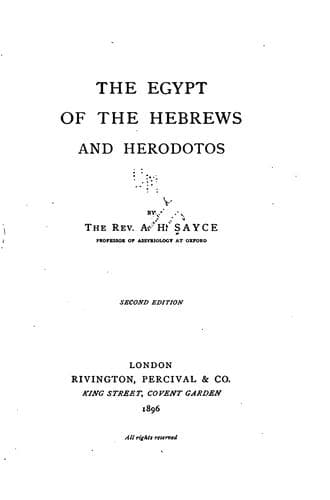
The Egypt of the Hebrews and HerodotosSayce, A. H. (Archibald Henry)
History
The Egypt of the Hebrews and Herodotos
Sayce, A. H. (Archibald Henry)
Egypt -- History, Ancient
Sabako, therefore, fixed his court at Zoan and Hanes, simply because they
had already become the leading cities, if not the capitals, of the north
and the south. And to Zoan and Hanes, accordingly, the Jewish envoys had
to make their way. The princes of Judah assembled at Zoan; the ambassadors
went farther, even to Hanes. It is noteworthy that a century later the
Assyrian king Assur-bani-pal still couples together the princes of Ahnas
and Zoan in his list of the satraps of Egypt.
Anysis or Hanes was the extreme limit of Herodotos’s voyage. As afterwards
in the days of Strabo, it was the entrance to the Fayyûm, and the
traveller who wished to visit the Fayyûm had first to pass through the
city which the Greeks called Herakleopolis. The patron-god of the city was
Hershef, whose name was the subject of various unsuccessful attempts at an
etymology on the part of the Egyptians. But, like the names of several
other deities, its true origin was lost in the night of antiquity. In
Plutarch it appears in a Greek dress as Arsaphes. The god was invested
with warlike attributes, and hence it was that he was identified by the
Greeks with their own Hêraklês. His temple stood in the middle of the
mounds of the old city, which the _fellahin_ call Umm el-Kimân, “the
mother of mounds.” In 1891 they were partially excavated by Dr. Naville
for the Egypt Exploration Fund, but little was found to repay the expense
and labour of the work. The site of the temple was discovered somewhat to
the north-east of the four columns which are alone left of an early Coptic
church. But hardly more than the site can be said still to exist. A few
blocks of stone inscribed with the names of Ramses II. and Meneptah, and a
fragment of a temple built by Usertesen II., are almost all that survive
of its past. Even the necropolis failed to produce monuments of antiquity.
Its tombs had been ransacked by treasure-hunters and used again as places
of burial in the Roman era, and Dr. Naville found in it only a few traces
of the eighteenth dynasty.
Public-domain text, read in full here on John Shaqi.
Reviews
Reviews
No reviews yet
Be the first to share your thoughts on this work.
Elsewhere in the archive
Join the Discussion
Join the discussion
Sign in to leave a comment or review.
Sign InorCreate an account