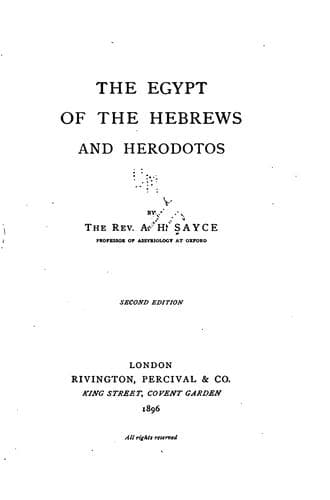
The Egypt of the Hebrews and HerodotosSayce, A. H. (Archibald Henry)
History
The Egypt of the Hebrews and Herodotos
Sayce, A. H. (Archibald Henry)
Egypt -- History, Ancient
From the walls of the city of the Crocodiles Herodotos looked out over a
vast expanse of water, which he thought was the creation of the Pharaohs,
but which was really the result of man’s neglect. The dykes were broken
which should have kept back the flood and prevented it from swamping the
summer crops. It was with this view of almost boundless waters that the
journey of Herodotos up the Nile came to an end. He returned to Memphis,
and from thence pursued the way along which we have followed him to
Pelusium and the sea. His note-book was filled with memoranda of all the
wonders he had seen; of the strange customs he had observed among the
Egyptian people; above all, with the folk-tales which his guides had
poured into his ear. At a later day, when his eastern travels were over,
and he had leisure for the work, he combined all this with the accounts
written by his predecessors, and added a new book to the libraries of
ancient Greece. From the outset it was a success, and though malicious
critics endeavoured to condemn and supersede it, though Thukydides
contradicted its statements in regard to Athens, though Ktêsias declared
that its oriental history was a romance and Plutarch discoursed on the
“malignity” of its author, the book survived all attacks. We have lost the
work of Hekatæos of Miletos, we have lost also—what is a more serious
misfortune—that of the careful and well-informed Hekatæos of Abdera, but
we still have Herodotos with us. And in spite of our own knowledge and his
ignorance, in spite even of his innocent vanity and appropriation of the
words of others, it is a pleasure to travel with him in our hand and visit
with him the scenes he saw. Nowhere else can we find the folk-lore which
grew and flourished in the meeting-place of East and West more than two
thousand years ago, and in which lay the germs of much of the folk-lore of
our own childhood. It may even be that some of the stories which the
modern dragoman relates to the modern traveller on the Nile have no better
parentage than the guides of Herodotos. Cairo is the successor of Memphis,
and ’the caste’ of the dragomen is not yet extinct.
APPENDICES.
Appendix I.
The Egyptian Dynasties According To Manetho (As Quoted By Julius
Africanus, A.D. 220), Etc.
[The excerpts of Africanus are known from George the Synkellos (A.D. 790)
and Eusebius (A.D. 326): where Eusebius differs from Synkellos the fact is
stated.]
(Each king is followed by the number of years reigned.)
DYNASTY I.—Thinites: 8 kings.
Public-domain text, read in full here on John Shaqi.
Reviews
Reviews
No reviews yet
Be the first to share your thoughts on this work.
Elsewhere in the archive
Join the Discussion
Join the discussion
Sign in to leave a comment or review.
Sign InorCreate an account