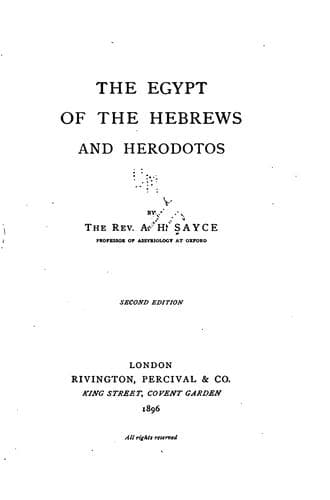
The Egypt of the Hebrews and HerodotosSayce, A. H. (Archibald Henry)
History
The Egypt of the Hebrews and Herodotos
Sayce, A. H. (Archibald Henry)
Egypt -- History, Ancient
Tut-ankh-Amon, 73.
Two brothers, Tale of, 25 _sqq._
Tyre, 72, 205, 234.
Tyrian camp, 242, 251.
Tyrsenians, 84.
U
Uaz, 235, 236, 237, 275.
Urd-Amon, 119.
Ur-mer, 240.
Usertesen I., 221, 251.
—— II., 19, 266, 270.
—— III., 282.
W
Wadi Tumilât (Goshen), 43.
Wiedemann, Professor, 39, 223.
Wilbour, Mr., 35.
X
Xanthos, 176.
Y
Yaud-hamelek, 109.
Z
Zagazig, 224.
Zahi, 72.
Zakkur, 84, 86, 88.
Zaphnath-paaneah, 32.
Zemar, 72.
Zenodotos, 147.
Zephyrion, 207.
Zerah, 111.
Zoan (Sân, Tanis), 15, 19, 39, 41, 42, 48, 78, 267.
FOOTNOTES
1 Hosea ix. 6; Isaiah xix. 13; Jeremiah ii. 16.
_ 2 Pyramids and Temples of Gizeh_ (first edition), p. 44.
_ 3 Pap. Anastasi_, i. p. 23, line 5.
4 Horner, in the _Philosophical Transactions of the Royal Society_,
1855-58.
5 Brugsch’s translation, _Egypt under the Pharaohs_, Eng. trans. first
edition, i. p. 266.
6 Ramses II. reigned from B.C. 1348 to 1281; if the stela of Sân had
been erected in the twenty-eighth year of his reign, four hundred
years would take us back to B.C. 1720. The Syrian wars were
concluded by the treaty with the Hittites in the twenty-first year
of his reign.
7 This is the length of the reign as given by Manetho, and with this
agree all the dated monuments of Hor-m-hib, with the exception of a
fragment in the British Museum (_Egyptian Inscriptions_, 5624),
which has been supposed to refer to his seventh and twenty-first
years. But the king to whom these dates refer is uncertain, and Dr.
Birch may be right in considering that Amenôphis is meant.
8 See Maspero’s exhaustive paper “The List of Sheshonq at Karnak,” in
the _Journal of the Transactions of the Victoria Institute_, xxvii.
(1893-94).
9 Sharpe, _History of Egypt_, i. p. 346.
10 The inscription of Sheri, the prophet of Send, part of which is in
the Ashmolean Museum at Oxford and part at Cairo, makes Per-ab-sen
the successor of Send. He will have corresponded to the Khaires of
Manetho.
11 In an inscription now at Palermo a King Ahtes is mentioned by the
side of Nefer-ar-ka-Ra.
12 In the tomb of Mera, discovered by Mr. de Morgan at Saqqârah in
1894, Akau-Hor stands between Unas and Teta.
13 One of the kings of the seventh dynasty was Dad-nefer-Ra Dudu-mes,
whose name is conjoined with those of the sixth dynasty kings at
El-Kab, and who built at Gebelên.
14 The last five names are thus given by Lauth.
15 The names of these six kings are found only on scarabs, and are
placed here by Professor Petrie.
16 Ameni is mentioned in a papyrus along with Khiti.
17 According to Lauth, the Turin papyrus gives nineteen kings to the
tenth dynasty, and 185 years.
18 According to Petrie’s arrangement. Lieblein further includes in the
dynasty, Ra-snefer-ka, Ra ..., User-n-Ra, Neb-nem-Ra, and An-âa.
Public-domain text, read in full here on John Shaqi.
Reviews
Reviews
No reviews yet
Be the first to share your thoughts on this work.
Elsewhere in the archive
Join the Discussion
Join the discussion
Sign in to leave a comment or review.
Sign InorCreate an account