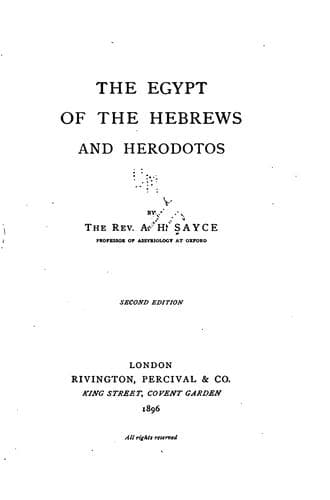
The Egypt of the Hebrews and HerodotosSayce, A. H. (Archibald Henry)
History
The Egypt of the Hebrews and Herodotos
Sayce, A. H. (Archibald Henry)
Egypt -- History, Ancient
Against the identification of Meneptah with the Pharaoh of the Exodus it
has, however, been urged that he seems on the whole to have been a
successful prince. His kingdom passed safely through the shock of the
Libyan and northern invasions, and notices which have survived to us show
that, at all events in the earlier part of his reign, Gaza and the
neighbouring towns still acknowledged his authority. At Zaru, on the
Asiatic frontier of Egypt, a young scribe, Pa-ebpasa by name, was
stationed, whose duty it was to keep a record of all those who entered or
left the country by “the way of the Philistines.” Some of his notes, made
in the third year of Meneptah, are entered on the back of his school
copybook, which is now in the British Museum. One of them tells us that on
the fifteenth of Pakhons Baal— ... the son of Zippor of Gaza, passed
through with a letter to Baal-marom(?)-ga[b]u, the prince of Tyre; another
that Thoth, the son of Zakarumu, and the policeman Duthau, the son of
Shem-baal, as well as Sutekh-mes, the son of Epher-dagal, had come from
Gaza with a message to the king.
A curious despatch, dated in Meneptah’s eighth year, goes to show that at
that time the kinsfolk of the Israelites still had liberty to pass from
the desert into the land of Goshen and there find pasturage for their
flocks. One of his officials informs him that certain Shasu or Bedouin
from Edom had been allowed to pass the Khetam or fortress of Meneptah
Hotep-hima in the district of Succoth, and make their way to the lakes of
the city of Pithom, in the district of Succoth, “in order to feed
themselves and their herds on the possessions of Pharaoh, who is there a
beneficent sun for all peoples.” The document may be interpreted in two
ways. It may be taken as a proof that the Israelites had not yet fled from
Egypt, and that there was consequently as yet no restraint placed by the
Egyptians upon the entrance of the Asiatic nomads into their country, or
it may be regarded as implying that the land of Goshen was already
deserted, so that there was abundance of room for both shepherds and
flocks. On behalf of this view a passage may be quoted from the great
inscription of Meneptah at Karnak, in which we read that “the country
around Pa-Bailos (the modern Belbeis) was not cultivated, but left as
pasture for cattle because of the strangers. It was abandoned since the
time of the ancestors.” More probably, however, this means that the land
in question was not inhabited by Egyptian _fellahin_, but given over to
the Hebrew shepherds and the “mixed multitude” of their Bedouin kinsmen.
Public-domain text, read in full here on John Shaqi.
Reviews
Reviews
No reviews yet
Be the first to share your thoughts on this work.
Join the Discussion
Join the discussion
Sign in to leave a comment or review.
Sign InorCreate an account